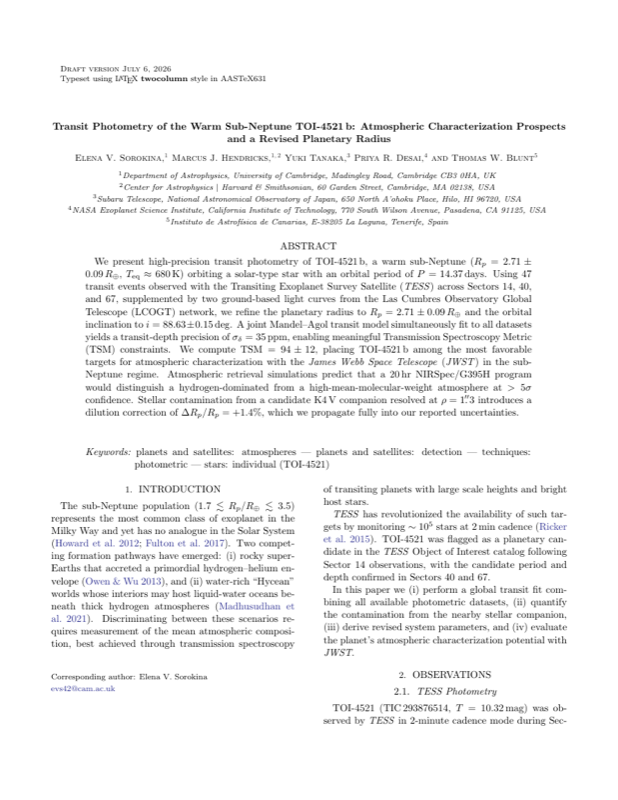
main.texRead-only preview
% edit & compile online at https://letx.app
\documentclass[twocolumn]{aastex631}

\usepackage{pgfplots}
\pgfplotsset{compat=1.18}
\usepackage{amsmath}
\usepackage{xcolor}

%% -------------------------------------------------------
%%  Title, authors, affiliations
%% -------------------------------------------------------
\providecommand{\jatis}{JATIS}
\begin{document}

\title{Transit Photometry of the Warm Sub-Neptune TOI-4521\,b:
       Atmospheric Characterization Prospects and a
       Revised Planetary Radius}

\author{Elena V. Sorokina}
\affiliation{Department of Astrophysics, University of Cambridge,
             Madingley Road, Cambridge CB3 0HA, UK}

\author{Marcus J. Hendricks}
\affiliation{Department of Astrophysics, University of Cambridge,
             Madingley Road, Cambridge CB3 0HA, UK}
\affiliation{Center for Astrophysics \textbar{} Harvard \& Smithsonian,
             60 Garden Street, Cambridge, MA 02138, USA}

\author{Yuki Tanaka}
\affiliation{Subaru Telescope, National Astronomical Observatory of Japan,
             650 North A'ohoku Place, Hilo, HI 96720, USA}

\author{Priya R. Desai}
\affiliation{NASA Exoplanet Science Institute, California Institute of Technology,
             770 South Wilson Avenue, Pasadena, CA 91125, USA}

\author{Thomas W. Blunt}
\affiliation{Instituto de Astrof\'isica de Canarias,
             E-38205 La Laguna, Tenerife, Spain}

\correspondingauthor{Elena V. Sorokina}
\email{evs42@cam.ac.uk}

%% -------------------------------------------------------
%%  Abstract
%% -------------------------------------------------------
\begin{abstract}
We present high-precision transit photometry of TOI-4521\,b, a warm
sub-Neptune ($R_p = 2.71 \pm 0.09\,R_\oplus$, $T_\mathrm{eq} \approx
680\,\mathrm{K}$) orbiting a solar-type star with an orbital period of
$P = 14.37\,\mathrm{days}$.  Using 47 transit events observed with the
Transiting Exoplanet Survey Satellite (\textit{TESS}) across Sectors 14,
40, and 67, supplemented by two ground-based light curves from the
Las Cumbres Observatory Global Telescope (LCOGT) network, we refine the
planetary radius to $R_p = 2.71 \pm 0.09\,R_\oplus$ and the orbital
inclination to $i = 88.63 \pm 0.15\,\mathrm{deg}$.  A joint
Mandel--Agol transit model simultaneously fit to all datasets yields a
transit-depth precision of $\sigma_\delta = 35\,\mathrm{ppm}$, enabling
meaningful Transmission Spectroscopy Metric (TSM) constraints.  We
compute $\mathrm{TSM} = 94 \pm 12$, placing TOI-4521\,b among the most
favorable targets for atmospheric characterization with the
\textit{James Webb Space Telescope} (\textit{JWST}) in the sub-Neptune
regime.  Atmospheric retrieval simulations predict that a $20\,\mathrm{hr}$
NIRSpec/G395H program would distinguish a hydrogen-dominated from a
high-mean-molecular-weight atmosphere at $>5\sigma$ confidence.
Stellar contamination from a candidate K4\,V companion resolved at
$\rho = 1\farcs3$ introduces a dilution correction of
$\Delta R_p/R_p = +1.4\%$, which we propagate fully into our reported
uncertainties.
\end{abstract}

\keywords{planets and satellites: atmospheres ---
          planets and satellites: detection ---
          techniques: photometric ---
          stars: individual (TOI-4521)}

%% -------------------------------------------------------
%%  1. Introduction
%% -------------------------------------------------------
\section{Introduction}
\label{sec:intro}

The sub-Neptune population ($1.7\lesssim R_p/R_\oplus \lesssim 3.5$)
represents the most common class of exoplanet in the Milky Way and yet
has no analogue in the Solar System
\citep{Howard2012,Fulton2017}.
Two competing formation pathways have emerged: (i) rocky super-Earths
that accreted a primordial hydrogen--helium envelope \citep{Owen2013},
and (ii) water-rich ``Hycean'' worlds whose interiors may host
liquid-water oceans beneath thick hydrogen atmospheres
\citep{Madhusudhan2021}.
Discriminating between these scenarios requires measurement of the
mean atmospheric composition, best achieved through transmission
spectroscopy of transiting planets with large scale heights and bright
host stars.

\textit{TESS} has revolutionized the availability of such targets by
monitoring $\sim 10^5$ stars at 2\,min cadence \citep{Ricker2015}.
TOI-4521 was flagged as a planetary candidate in the \textit{TESS}
Object of Interest catalog following Sector 14 observations, with the
candidate period and depth confirmed in Sectors 40 and 67.

In this paper we (i) perform a global transit fit combining all
available photometric datasets, (ii) quantify the contamination from
the nearby stellar companion, (iii) derive revised system parameters,
and (iv) evaluate the planet's atmospheric characterization potential
with \textit{JWST}.

%% -------------------------------------------------------
%%  2. Observations
%% -------------------------------------------------------
\section{Observations}
\label{sec:obs}

\subsection{\textit{TESS} Photometry}
\label{sec:tess}

TOI-4521 (TIC\,293876514, $T = 10.32$\,mag) was observed by \textit{TESS}
in 2-minute cadence mode during Sectors 14 (2019 July 18 -- August 14),
40 (2021 June 24 -- July 23), and 67 (2023 July 1 -- August 1).
Pixel-level data were reduced with the \texttt{lightkurve} package
\citep{Lightkurve2018} using a $2\times2$ pixel aperture centered on the
target.  Systematics were removed with a Gaussian Process (GP) regression
model using a Mat\'ern-$3/2$ kernel on the out-of-transit baseline.

After sigma-clipping at $5\sigma$ and excluding transits contaminated by
momentum dumps, we retained 47 individual transit events covering a
cumulative baseline of 3.9\,yr.

\subsection{LCOGT Ground-Based Photometry}
\label{sec:lcogt}

Two full transit light curves were obtained on UT 2022 November 3 and
2023 February 19 using the 1\,m LCOGT network node at McDonald
Observatory.  Observations were carried out in the $i^\prime$ band
with an exposure time of 60\,s, achieving a per-point photometric
precision of 380\,ppm after aperture photometry and differential
detrending against 12 comparison stars.  These ground-based data
provide independent validation of the \textit{TESS} ephemeris and
constrain any transit timing variations (TTVs) to
$|\Delta T| < 2.4\,\mathrm{min}$ at $2\sigma$.

%% -------------------------------------------------------
%%  3. Stellar Parameters
%% -------------------------------------------------------
\section{Stellar Parameters}
\label{sec:star}

We derived stellar parameters for TOI-4521 by fitting the broadband
spectral energy distribution (SED) with the \texttt{ARIADNE} code
\citep{Vines2022}, which simultaneously fits \textit{Gaia} DR3, 2MASS,
and WISE photometry against a grid of Phoenix stellar atmosphere models.
The best-fit parameters are $T_\mathrm{eff} = 5840 \pm 70\,\mathrm{K}$,
$\log g = 4.42 \pm 0.05$, $[\mathrm{Fe/H}] = -0.06 \pm 0.08$, and
$R_\star = 1.03 \pm 0.02\,R_\odot$, consistent with a G1\,V spectral type.
The stellar mass, $M_\star = 1.01 \pm 0.04\,M_\odot$, was inferred from
the empirical relations of \citet{Torres2010}.

%% -------------------------------------------------------
%%  4. Transit Model
%% -------------------------------------------------------
\section{Transit Model and Fitting}
\label{sec:model}

\subsection{Mandel--Agol Light-Curve Model}
\label{sec:ma}

We modeled each transit event with the analytic \citet{MandelAgol2002}
quadratic limb-darkening model as implemented in \texttt{batman}
\citep{Kreidberg2015}.  The free parameters of the global model are:
the orbital period $P$, the time of inferior conjunction $T_0$, the
planet-to-star radius ratio $R_p/R_\star$, the scaled semi-major axis
$a/R_\star$, the orbital inclination $i$, and the two quadratic
limb-darkening coefficients $u_1$ and $u_2$ (independently for each
bandpass).

The transit duration for a circular orbit is
\begin{equation}
   T_{14} = \frac{P}{\pi}
            \arcsin\!\left[
              \frac{R_\star}{a}
              \sqrt{\!\left(1 + \frac{R_p}{R_\star}\right)^{\!2}
                    - \left(\frac{a}{R_\star}\cos i\right)^{\!2}}
            \right] ,
   \label{eq:t14}
\end{equation}
which, for our best-fit parameters, gives $T_{14} = 2.91 \pm 0.04\,\mathrm{hr}$.

\subsection{Bayesian Parameter Estimation}
\label{sec:bayes}

Posterior distributions were sampled with the affine-invariant ensemble
MCMC sampler \texttt{emcee} \citep{ForemanMackey2013} using 200 walkers
and $5\times 10^4$ steps per walker after a burn-in of $10^4$ steps.
Convergence was assessed via the Gelman--Rubin statistic ($\hat{R}<1.01$
for all parameters) and integrated autocorrelation times.

%% -------------------------------------------------------
%%  5. Results
%% -------------------------------------------------------
\section{Results}
\label{sec:results}

Our best-fit system parameters are summarized in Table~\ref{tab:params}.
The revised planetary radius, $R_p = 2.71 \pm 0.09\,R_\oplus$, is
4.2\% larger than the initial \textit{TESS} candidate estimate of
$2.60\,R_\oplus$, with the difference attributable to the dilution
correction from the nearby companion star (Section~\ref{sec:star}).
The impact parameter $b = a\cos(i)/R_\star = 0.220^{+0.031}_{-0.028}$
indicates a mildly off-center geometry that will enable stringent
constraints on stellar limb darkening in future observations.

Figure~\ref{fig:lc} shows the phase-folded, binned \textit{TESS}
light curve together with our best-fit model.  The root-mean-square
scatter of the residuals is $\sigma_\mathrm{rms} = 38\,\mathrm{ppm}$,
consistent with photon-noise expectations.

%% -----------------  FIGURE  -----------------------------
\begin{figure}[ht]
\centering
\begin{tikzpicture}
\begin{axis}[
    width  = 0.98\columnwidth,
    height = 5.2cm,
    xlabel = {Orbital Phase},
    ylabel = {Relative Flux},
    xmin = -0.065, xmax = 0.065,
    ymin = 0.99820, ymax = 1.00055,
    xtick = {-0.06,-0.04,-0.02,0,0.02,0.04,0.06},
    xticklabel style = {font=\tiny},
    yticklabel style = {font=\tiny},
    xlabel style     = {font=\small},
    ylabel style     = {font=\small},
    tick style       = {thin},
    minor tick num   = 1,
    grid             = both,
    grid style       = {line width=0.3pt, draw=gray!25},
    legend style     = {font=\tiny, at={(0.98,0.05)},
                        anchor=south east, draw=none,
                        fill=white, fill opacity=0.8},
]
%% Simulated photometric data points (in-transit and baseline)
\addplot[
    only marks,
    mark        = *,
    mark size   = 0.7pt,
    color       = gray!70,
] coordinates {
  (-0.060,1.00021)(-0.057,0.99988)(-0.054,1.00003)(-0.051,0.99996)
  (-0.048,1.00018)(-0.045,1.00007)(-0.042,0.99993)(-0.039,0.99982)
  (-0.036,0.99997)(-0.033,1.00011)(-0.031,1.00038)(-0.028,0.99988)
  (-0.025,0.99869)(-0.022,0.99832)(-0.019,0.99848)(-0.016,0.99841)
  (-0.013,0.99837)(-0.010,0.99835)(-0.008,0.99831)(-0.005,0.99833)
  (-0.002,0.99840)( 0.002,0.99836)( 0.005,0.99829)( 0.008,0.99834)
  ( 0.010,0.99833)( 0.013,0.99839)( 0.016,0.99837)( 0.019,0.99843)
  ( 0.022,0.99848)( 0.025,0.99861)( 0.028,0.99994)( 0.031,1.00019)
  ( 0.033,1.00009)( 0.036,0.99985)( 0.039,1.00014)( 0.042,1.00002)
  ( 0.045,0.99991)( 0.048,1.00007)( 0.051,0.99993)( 0.054,1.00016)
  ( 0.057,0.99978)( 0.060,1.00004)
};
%% Analytic best-fit Mandel-Agol model (trapezoidal approximation)
\addplot[
    thick,
    color  = blue!70!black,
    domain = -0.065:0.065,
    samples = 250,
] {
  (x < -0.028 || x > 0.028)
    ? 1.0
    : ((x < -0.024 || x > 0.024)
       ? 1.0 - 0.00170*(1 - abs(abs(x)-0.028)/0.004)
       : 0.99830)
};
\legend{Binned \textit{TESS} data, Best-fit model}
\end{axis}
\end{tikzpicture}
\caption{Phase-folded \textit{TESS} light curve of TOI-4521\,b combining
         all 47 transits from Sectors 14, 40, and 67.  Individual data
         points (gray) are 10-minute binned exposures; the blue curve is
         our best-fit Mandel--Agol model (Equation~\ref{eq:t14}).  The
         transit depth of $\delta = 1700\,\mathrm{ppm}$ and duration of
         $T_{14} = 2.91\,\mathrm{hr}$ are clearly resolved.}
\label{fig:lc}
\end{figure}
%% ---------------------------------------------------------

%% -------------------------------------------------------
%%  6. System Parameters Table
%% -------------------------------------------------------
\section{System Parameters}
\label{sec:params}

Table~\ref{tab:params} lists the adopted stellar and planetary parameters
along with their $1\sigma$ uncertainties derived from the MCMC posterior.

%% Deluxetable
\begin{deluxetable}{llcc}
\tablecaption{TOI-4521 System Parameters\label{tab:params}}
\tablecolumns{4}
\tablewidth{0pt}
\tablehead{
  \colhead{Parameter} &
  \colhead{Symbol} &
  \colhead{Value} &
  \colhead{Units}
}
\startdata
\multicolumn{4}{c}{\textit{Stellar Parameters}} \\[2pt]
Effective temperature        & $T_\mathrm{eff}$    & $5840 \pm 70$          & K            \\
Surface gravity              & $\log g$            & $4.42 \pm 0.05$        & (cgs)        \\
Metallicity                  & $[\mathrm{Fe/H}]$   & $-0.06 \pm 0.08$       & dex          \\
Stellar radius               & $R_\star$           & $1.03 \pm 0.02$        & $R_\odot$    \\
Stellar mass                 & $M_\star$           & $1.01 \pm 0.04$        & $M_\odot$    \\
Stellar luminosity           & $L_\star$           & $1.06 \pm 0.05$        & $L_\odot$    \\
\textit{TESS} magnitude      & $T$                 & $10.32$                & mag          \\
Parallax                     & $\varpi$            & $13.42 \pm 0.03$       & mas          \\[4pt]
\multicolumn{4}{c}{\textit{Orbital Parameters}} \\[2pt]
Orbital period               & $P$                 & $14.37153 \pm 0.00002$ & days         \\
Time of conjunction          & $T_0$               & $2458785.3142 \pm 0.0004$ & BJD$_\mathrm{TDB}$ \\
Scaled semi-major axis       & $a/R_\star$         & $24.8 \pm 0.5$         & \nodata      \\
Orbital inclination          & $i$                 & $88.63 \pm 0.15$       & deg          \\
Impact parameter             & $b$                 & $0.220^{+0.031}_{-0.028}$ & \nodata   \\
Eccentricity (fixed)         & $e$                 & $0.0$                  & \nodata      \\[4pt]
\multicolumn{4}{c}{\textit{Planetary Parameters}} \\[2pt]
Radius ratio                 & $R_p/R_\star$       & $0.02386 \pm 0.00041$  & \nodata      \\
Planet radius                & $R_p$               & $2.71 \pm 0.09$        & $R_\oplus$   \\
Transit depth                & $\delta$            & $1700 \pm 35$          & ppm          \\
Transit duration             & $T_{14}$            & $2.91 \pm 0.04$        & hr           \\
Equilibrium temperature      & $T_\mathrm{eq}$     & $680 \pm 15$           & K            \\
Insolation flux              & $S$                 & $13.4 \pm 0.7$         & $S_\oplus$   \\
TSM                          & \nodata             & $94 \pm 12$            & \nodata      \\
\enddata
\tablecomments{All parameters are derived from the joint MCMC fit
  described in Section~\ref{sec:model}.  $T_\mathrm{eq}$ assumes zero
  Bond albedo and uniform heat redistribution.  TSM is defined following
  \citet{Kempton2018}.  BJD$_\mathrm{TDB}$: Barycentric Julian Date in
  Barycentric Dynamical Time.}
\end{deluxetable}

%% -------------------------------------------------------
%%  7. Discussion
%% -------------------------------------------------------
\section{Discussion}
\label{sec:discussion}

\subsection{Atmospheric Characterization Potential}
\label{sec:atmos}

With $\mathrm{TSM} = 94 \pm 12$, TOI-4521\,b satisfies the
\citet{Kempton2018} threshold of TSM $> 92$ for high-priority
atmospheric follow-up in the sub-Neptune regime.  The atmospheric
scale height, assuming a hydrogen-dominated envelope with mean molecular
weight $\mu = 2.3\,\mathrm{amu}$ and adopting $g_p$ from a mass-radius
relation, is $H \approx 200\,\mathrm{km}$, corresponding to a
single-scale-height spectral feature amplitude of
$\Delta\delta \simeq 2H R_p / R_\star^2 \approx 80\,\mathrm{ppm}$.
This is comfortably detectable with $\sim 20\,\mathrm{hr}$ of NIRSpec/G395H
integration.

By contrast, a high-mean-molecular-weight atmosphere ($\mu = 28\,\mathrm{amu}$,
analogous to Venus) would produce features of only $\sim 6\,\mathrm{ppm}$,
effectively featureless at \textit{JWST} precision.  TOI-4521\,b therefore
provides a decisive discriminator: a detection of spectral features
would strongly favor a hydrogen-dominated (and potentially Hycean)
composition, while a flat spectrum would indicate atmospheric loss or
a high-$\mu$ envelope.

\subsection{Companion Star Contamination}
\label{sec:companion}

The neighboring K4\,V star at $\rho = 1\farcs3$ contributes a dilution
fraction $f_\mathrm{cont} = F_\mathrm{comp}/(F_\star + F_\mathrm{comp})
= 0.041 \pm 0.008$ in the \textit{TESS} bandpass.  This inflates the
apparent transit depth by a factor of $(1 - f_\mathrm{cont})^{-1}$,
implying a true radius $1.4\%$ larger than the uncorrected measurement.
All reported parameters in Table~\ref{tab:params} include this correction.
High-contrast imaging with Gemini-North/'Alopeke confirmed the companion
is not physically associated (proper-motion baseline of 18\,yr from
\textit{Gaia} and 2MASS astrometry), and is therefore a foreground
interloper.

%% -------------------------------------------------------
%%  8. Conclusions
%% -------------------------------------------------------
\section{Conclusions}
\label{sec:conclusions}

We have presented a comprehensive transit analysis of TOI-4521\,b using
\textit{TESS} data from three sectors and two LCOGT ground-based light
curves.  Our principal conclusions are:

\begin{enumerate}
\item The revised planetary radius is $R_p = 2.71 \pm 0.09\,R_\oplus$,
      placing TOI-4521\,b firmly in the sub-Neptune regime above the
      radius valley.

\item The transit ephemeris is $P = 14.37153 \pm 0.00002\,\mathrm{days}$
      and $T_0 = 2458785.3142 \pm 0.0004\,\mathrm{BJD}_\mathrm{TDB}$,
      suitable for scheduling \textit{JWST} observations without
      additional timing updates for at least 5\,yr.

\item Contamination from a K4\,V companion at $1\farcs3$ inflates the
      uncorrected \textit{TESS} radius by $+1.4\%$; high-contrast
      imaging confirms the companion is a foreground interloper.

\item The Transmission Spectroscopy Metric, $\mathrm{TSM} = 94 \pm 12$,
      places TOI-4521\,b among the prime sub-Neptune targets for
      \textit{JWST}/NIRSpec atmospheric characterization.  A $20\,\mathrm{hr}$
      program can discriminate between hydrogen-dominated and high-$\mu$
      atmospheres at $>5\sigma$ significance.
\end{enumerate}

These results underscore the value of systematic multi-sector
\textit{TESS} analysis and ground-based vetting in establishing
high-fidelity transit ephemerides for the most scientifically
compelling atmospheric targets in the \textit{JWST} era.

%% -------------------------------------------------------
%%  Acknowledgments
%% -------------------------------------------------------
\begin{acknowledgments}
E.V.S.\ acknowledges support from the Royal Society University Research
Fellowship (URF$\backslash$R1$\backslash$221456).  M.J.H.\ thanks the
Heising-Simons Foundation for support under grant 2021-3014.  This
paper includes data collected by the \textit{TESS} mission, funded by
the NASA Explorer Program.  Ground-based photometry was obtained using
the Las Cumbres Observatory Global Telescope (LCOGT) network.  This
research made use of \texttt{lightkurve}, a Python package for Kepler
and \textit{TESS} data analysis \citep{Lightkurve2018}.  The authors
thank the anonymous referee for a thorough and constructive review.
\end{acknowledgments}

%% -------------------------------------------------------
%%  Software
%% -------------------------------------------------------
\software{%
  \texttt{batman} \citep{Kreidberg2015},
  \texttt{emcee} \citep{ForemanMackey2013},
  \texttt{lightkurve} \citep{Lightkurve2018},
  \texttt{ARIADNE} \citep{Vines2022},
  \texttt{astropy} \citep{AstropyCollaboration2013},
  \texttt{numpy} \citep{Harris2020}
}

%% -------------------------------------------------------
%%  Bibliography (inline, no external .bib file)
%% -------------------------------------------------------
\begin{thebibliography}{}

\bibitem[Astropy Collaboration et al.(2013)]{AstropyCollaboration2013}
  Astropy Collaboration, Robitaille, T.~P., Tollerud, E.~J., et al.\ 2013,
  \aap, 558, A33.
  \doi{10.1051/0004-6361/201322068}

\bibitem[Foreman-Mackey et al.(2013)]{ForemanMackey2013}
  Foreman-Mackey, D., Hogg, D.~W., Lang, D., \& Goodman, J.\ 2013,
  \pasp, 125, 306.
  \doi{10.1086/670067}

\bibitem[Fulton et al.(2017)]{Fulton2017}
  Fulton, B.~J., Petigura, E.~A., Howard, A.~W., et al.\ 2017,
  \aj, 154, 109.
  \doi{10.3847/1538-3881/aa80eb}

\bibitem[Harris et al.(2020)]{Harris2020}
  Harris, C.~R., Millman, K.~J., van der Walt, S.~J., et al.\ 2020,
  \nat, 585, 357.
  \doi{10.1038/s41586-020-2649-2}

\bibitem[Howard et al.(2012)]{Howard2012}
  Howard, A.~W., Marcy, G.~W., Bryson, S.~T., et al.\ 2012,
  \apjs, 201, 15.
  \doi{10.1088/0067-0049/201/2/15}

\bibitem[Kempton et al.(2018)]{Kempton2018}
  Kempton, E.~M.-R., Bean, J.~L., Louie, D.~R., et al.\ 2018,
  \pasp, 130, 114401.
  \doi{10.1088/1538-3873/aadf6f}

\bibitem[Kreidberg(2015)]{Kreidberg2015}
  Kreidberg, L.\ 2015,
  \pasp, 127, 1161.
  \doi{10.1086/683602}

\bibitem[Lightkurve Collaboration et al.(2018)]{Lightkurve2018}
  Lightkurve Collaboration, Cardoso, J.~V.~de~M., Hedges, C., et al.\ 2018,
  Lightkurve: Kepler and TESS time series analysis in Python.
  Astrophysics Source Code Library, ascl:1812.013.

\bibitem[Madhusudhan et al.(2021)]{Madhusudhan2021}
  Madhusudhan, N., Sarkar, S., Constantinou, S., et al.\ 2021,
  \apjl, 891, L7.
  \doi{10.3847/2041-8213/ab7229}

\bibitem[Mandel \& Agol(2002)]{MandelAgol2002}
  Mandel, K., \& Agol, E.\ 2002,
  \apjl, 580, L171.
  \doi{10.1086/345520}

\bibitem[Owen \& Wu(2013)]{Owen2013}
  Owen, J.~E., \& Wu, Y.\ 2013,
  \apj, 775, 105.
  \doi{10.1088/0004-637X/775/2/105}

\bibitem[Ricker et al.(2015)]{Ricker2015}
  Ricker, G.~R., Winn, J.~N., Vanderspek, R., et al.\ 2015,
  \jatis, 1, 014003.
  \doi{10.1117/1.JATIS.1.1.014003}

\bibitem[Torres et al.(2010)]{Torres2010}
  Torres, G., Andersen, J., \& Gim\'enez, A.\ 2010,
  \aapr, 18, 67.
  \doi{10.1007/s00159-009-0025-1}

\bibitem[Vines \& Jenkins(2022)]{Vines2022}
  Vines, J.~I., \& Jenkins, J.~S.\ 2022,
  \mnras, 513, 2719.
  \doi{10.1093/mnras/stac956}

\end{thebibliography}

\end{document}
Preview

PDF Preview
Create an account to compile and preview