main.texRead-only preview
\documentclass[]{article}

%%%%%%%%%%%%%%%%%%%
% Packages/Macros %
%%%%%%%%%%%%%%%%%%%
\usepackage{amssymb,latexsym,amsmath}     % Standard packages


%%%%%%%%%%%
% Margins %
%%%%%%%%%%%
\addtolength{\textwidth}{1.0in}
\addtolength{\textheight}{1.00in}
\addtolength{\evensidemargin}{-0.75in}
\addtolength{\oddsidemargin}{-0.75in}
\addtolength{\topmargin}{-.50in}


%%%%%%%%%%%%%%%%%%%%%%%%%%%%%%
% Theorem/Proof Environments %
%%%%%%%%%%%%%%%%%%%%%%%%%%%%%%
\newtheorem{theorem}{Theorem}
\newenvironment{proof}{\noindent{\bf Proof:}}{$\hfill \Box$ \vspace{10pt}}


%%%%%%%%%%%%
% Document %
%%%%%%%%%%%%
\begin{document}

\title{Sample \LaTeX ~File}
\author{David P. Little}
\maketitle

\begin{abstract}
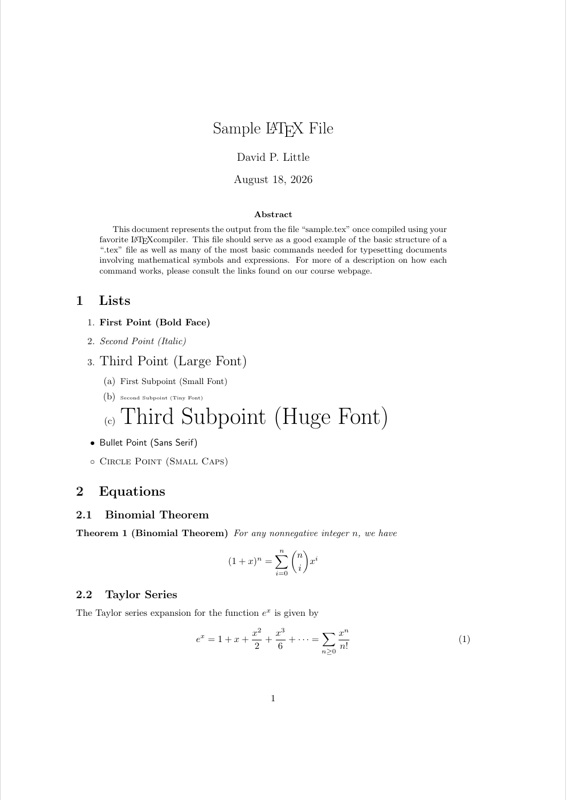
This document represents the output from the file ``sample.tex" once compiled using your favorite \LaTeX compiler.  This file should serve as a good example of the basic structure of a ``.tex" file as well as many of the most basic commands needed for typesetting documents involving mathematical symbols and expressions.  For more of a description on how each command works, please consult the links found on our course webpage.
\end{abstract}


\section{Lists}
%%%%%%%%%%%%%%%
\begin{enumerate}
\item {\bf First Point (Bold Face)}
\item {\em Second Point (Italic)}
\item {\Large Third Point (Large Font)}
    \begin{enumerate}
        \item {\small First Subpoint (Small Font)}
        \item {\tiny Second Subpoint (Tiny Font)}
        \item {\Huge Third Subpoint (Huge Font)}
    \end{enumerate}
\item[$\bullet$] {\sf Bullet Point (Sans Serif)}
\item[$\circ$] {\sc Circle Point (Small Caps)}
\end{enumerate}


\section{Equations}
%%%%%%%%%%%%%%%%%%%

\subsection{Binomial Theorem}
\begin{theorem}[Binomial Theorem]
For any nonnegative integer $n$, we have
$$(1+x)^n = \sum_{i=0}^n {n \choose i} x^i$$
\end{theorem}

\subsection{Taylor Series}
The Taylor series expansion for the function $e^x$ is given by
\begin{equation}
e^x = 1 + x + \frac{x^2}{2} + \frac{x^3}{6} + \cdots = \sum_{n\geq 0} \frac{x^n}{n!}
\end{equation}


\subsection{Sets}

\begin{theorem}
For any sets $A$, $B$ and $C$, we have
$$ (A\cup B)-(C-A) = A \cup (B-C)$$
\end{theorem}

\begin{proof}
\begin{eqnarray*}
(A\cup B)-(C-A) &=& (A\cup B) \cap (C-A)^c\\
&=& (A\cup B) \cap (C \cap A^c)^c \\
&=& (A\cup B) \cap (C^c \cup A) \\
&=& A \cup (B\cap C^c) \\
&=& A \cup (B-C)
\end{eqnarray*}
\end{proof}


\section{Tables}
%%%%%%%%%%%%%%%%
\begin{center}
\begin{tabular}{l||c|r}
left justified & center & right justified \\ \hline
1 & 3.14159 & 5 \\
2.4678 & 3 &  1234 \\ \hline \hline
3.4678 & 6.14159 & 1239
\end{tabular}
\end{center}


\section{A Picture}
%%%%%%%%%%%%%%%%%%%
\begin{center}
\begin{picture}(100,100)(0,0)
\setlength{\unitlength}{1pt}
\put(20,70){\circle{30}}  \put(20,70){\circle*{10}}   % left eye
\put(80,70){\circle{30}}  \put(80,70){\circle*{10}}   % right eye
\put(40,40){\line(1,2){10}} \put(60,40){\line(-1,2){10}} \put(40,40){\line(1,0){20}} % nose
\put(50,20){\oval(80,10)[b]} % mouth
\multiput(0,90)(4,0){10}{\line(1,3){4}}  % left eyebrow
\multiput(100,90)(-4,0){10}{\line(-1,3){4}}  % right eyebrow
\end{picture}
\end{center}


\end{document}
Preview

PDF Preview
Create an account to compile and preview