example.texRead-only preview
\documentclass[name=Jacob\ Strieb, andrewid=jstrieb, course=69-420, num=4]{homework}

\usepackage{hw-shortcuts}

\begin{document}

\problem{1a}

\begin{claim}
    The set of rational numbers ($\Q$) is countable.
\end{claim}
\begin{proof}
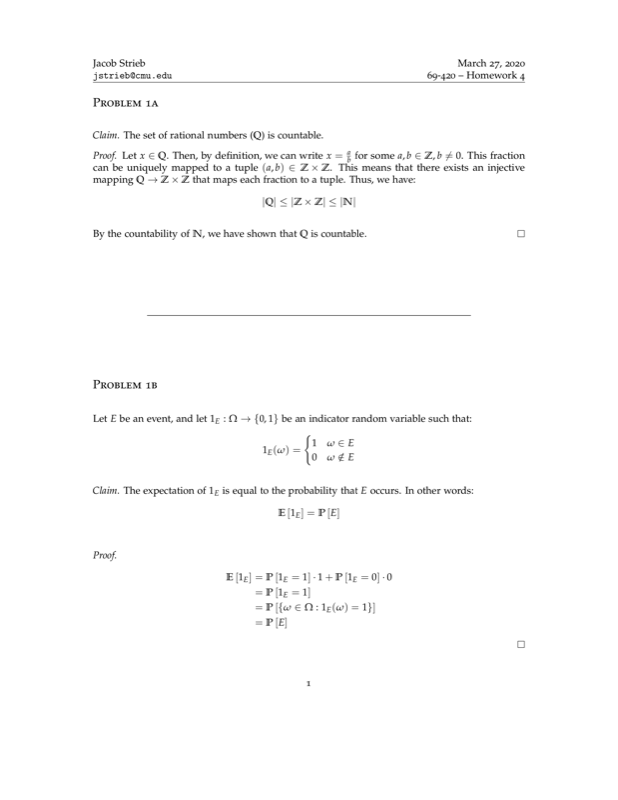
    Let $x \in \Q$. Then, by definition, we can write $x = \frac{a}{b}$ for some $a, b \in \Z, b \neq 0$. This fraction can be uniquely mapped to a tuple $(a, b) \in \Z \times \Z$. This means that there exists an injective mapping $\Q \to \Z \times \Z$ that maps each fraction to a tuple. Thus, we have:
    $$ |\Q| \leq |\Z \times \Z| \leq |\N| $$

    By the countability of $\N$, we have shown that $\Q$ is countable.
\end{proof}

\separator

\problem{1b}
Let $E$ be an event, and let $1_E : \Omega \to \{ 0, 1 \}$ be an indicator random variable such that:
$$ 1_E(\omega) = \begin{cases}
1 & \omega \in E \\
0 & \omega \notin E
\end{cases} $$

\begin{claim}
    The expectation of $1_E$ is equal to the probability that $E$ occurs. In other words:
    $$ \expect{1_E} = \prob{E} $$
\end{claim}
\begin{proof}
    \begin{align*}
    \expect{1_E} &= \prob{1_E = 1} \cdot 1 + \prob{1_E = 0} \cdot 0 \\
    &= \prob{1_E = 1} \\
    &= \prob{ \{ \omega \in \Omega : 1_E(\omega) = 1 \} } \\
    &= \prob{E}
    \end{align*}
\end{proof}
\newpage

\problem2

\begin{claim}
    $e^{iy} = \cos y + i \sin y$ for $y \in \R$
\end{claim}
\begin{proof}
    We begin by noting that $e^x = \sum_{i = 0}^\infty \frac{x^i}{i!}$. Plugging in $x = yi$ for the exponent in $e^x$ gives:
    \begin{align*}
    e^{yi} &= \sum_{n = 0}^\infty \frac{(yi)^n}{n!} \\
    &= \sum_{n = 0}^\infty \frac{y^{4n}}{(4n)!} + \sum_{n = 0}^\infty i \cdot \frac{y^{4n + 1}}{(4n + 1)!} + \sum_{n = 0}^\infty -1 \cdot \frac{y^{4n + 2}}{(4n + 2)!} + \sum_{n = 0}^\infty -i \cdot \frac{y^{4n + 3}}{(4n + 3)!} \\
    &= \sum_{n = 0}^\infty \frac{y^{4n}}{(4n)!} - \frac{y^{4n + 2}}{(4n + 2)!} + i \lrp{ \sum_{n = 0}^\infty \frac{y^{4n + 1}}{(4n + 1)!} - \frac{y^{4n + 3}}{(4n + 3)!} } \\
    &= \sum_{n = 0}^\infty \frac{(-1)^n y^{2n}}{(2n)!} + i \lrp{\sum_{n = 0}^\infty \frac{(-1)^n y^{2n + 1}}{(2n + 1)!}} \\
    &= \cos y + i \sin y
    \end{align*}

    This equality holds because the series representations of $\sin$ and $\cos$ are convergent. Thus, $e^{iy} = \cos y + i \sin y$ for $y \in \R$, as required.
\end{proof}
\newpage

\problem{3}
\begin{claim}
    $\P \neq \NP$
\end{claim}

\begin{proof}
    We have already shown that $\P \subseteq \NP$, so to prove that $\NP \neq \P$ it suffices to show that $\NP \not \subseteq \P$. We begin by fixing a language $L \in \NP$.

    \todo % TODO: Complete this problem later
\end{proof}
\newpage

\problem4

\begin{claim}
    Two identical decks of $n$ cards have a $k$-matching with probability:
    $$ \pi_k = \frac1{k!} \lrp{ 1 - \sum_{i = 1}^{n - k} \frac{(-1)^i}{i!} } $$
\end{claim}
\begin{proof}
    First, we pick and order $k$ cards to be matched. The probability of the selected card orders matching is $\frac{1}{k!}$.

    Now, we consider the probability that the remaining $n - k$ cards \textit{do not} match. Similar to the examples from class and the textbook, this is an instance of an indexed union of sets $A_i \in \mathcal{F}$ such that $A_i$ is the set of permutations in which $f(i) = i$. But since we are looking for the probability of this not happening, we consider the probability of the complement, computed as $1$ minus the probability of this union of events.

    By the Inclusion-Exclusion principle, based on the notes from class, we have that:
    $$ \prob{ \bigcup_{i = 1}^{n - k} A_i } = \sum_{i = 1}^{n - k} \frac{(-1)^i}{i!} $$

    Putting everything together, we get the following, and we're done.
    $$ \pi_k = \frac1{k!} \lrp{ 1 - \sum_{i = 1}^{n - k} \frac{(-1)^i}{i!} }$$
\end{proof}


\end{document}
Preview

PDF Preview
Create an account to compile and preview