main.texRead-only preview
% Written by Bibby AI
\documentclass[aspectratio=169, xcolor={dvipsnames}, hyperref={colorlinks=true,linkcolor=themecolor, urlcolor=magenta,citecolor=violet, hyperfootnotes=true}]{beamer}
\input{header.tex}


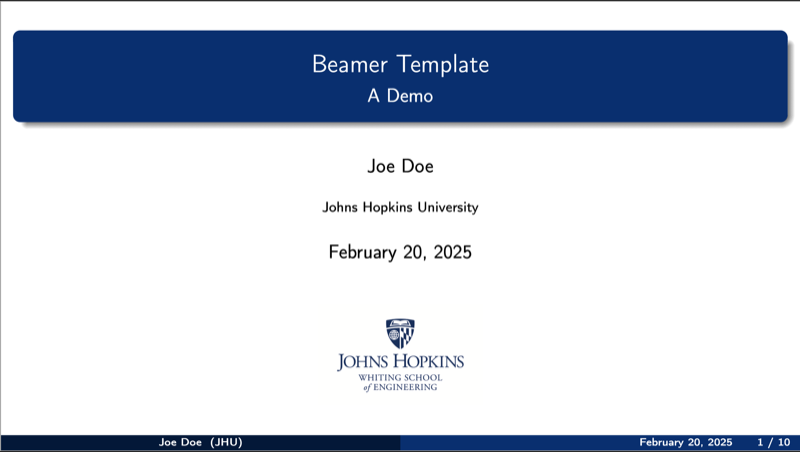
\title{Beamer Template}
\subtitle{A Demo}
\institute[JHU]{Johns Hopkins University}
\author{Joe Doe}

\addbibresource{reference.bib}

\begin{document}

\begin{frame}
    \titlepage
\end{frame}

\begin{frame}{Table of Content}
    \tableofcontents[hideallsubsections]
\end{frame}

\AtBeginSubsection[]{\begin{frame}<beamer>\frametitle{Table of Content}\tableofcontents[currentsection,currentsubsection,subsectionstyle=show/shaded/hide]\end{frame}}
\section{Math}
\begin{frame}
    \frametitle{Math}
    Wo do math in beamer. Here are some examples:
    \begin{itemize}
        \item Inline math: $a^2 + b^2 = c^2$.
        \item Display math:
              \begin{equation}
                  \int_{-\infty}^{\infty} e^{-x^2} dx = \sqrt{\pi}.
              \end{equation}
        \item Align environment:
              \begin{align}
                  a & = b + c \\
                  & = d + e.
              \end{align}
    \end{itemize}
\end{frame}


\section{Useful Environment}
\subsection{Standard Environment}
\begin{frame}{\texttt{itemize} and \texttt{enumerate}}
    This is a demonstration of various environments. The first is \texttt{itemize}:

    \begin{itemize}
        \item Item 1
        \item Item 2
        \item etc.
    \end{itemize}

    Usually I'll use \texttt{enumerate} as well:

    \begin{enumerate}
        \item Item 1
        \item Item 2
        \item etc.
    \end{enumerate}
\end{frame}

\subsection{Customized Environment}

\begin{frame}{Definition, Examples, etc.}
    All the common environments are available, e.g.,
    \begin{itemize}
        \item \emph{Theorem}-related: \texttt{lemma}, \texttt{theorem}, \texttt{corollary}.
        \item \emph{Common} environments: \texttt{definition}, \texttt{example}, \texttt{problem}.
        \item \emph{Others}: \texttt{prev}, \texttt{observe}, \texttt{assumption}, \texttt{remark}, \texttt{intuition}.
    \end{itemize}

    I'll just show you two examples:

    \begin{example}[A demonstration]
        This is an \texttt{example} environment.
    \end{example}

    \begin{prev}
        This is a \texttt{prev} environment.
    \end{prev}
\end{frame}

\subsection{Citation}
\begin{frame}{Citation}
    We can cite papers using \texttt{biblatex}.
    \begin{itemize}
        \item This is a citation \cite{smith2025example}.
        \item This is another citation \cite{johnson2024innovative, lee2023computational}.
        \item This is a link \url{https://www.google.com}.
    \end{itemize}
\end{frame}

\section{References}

\begin{frame}{References}
    \printbibliography
\end{frame}


% Written by Bibby AI
\end{document}
Preview

PDF Preview
Create an account to compile and preview