main.texRead-only preview
%% =====================================================================
%%  KinaMind Society -- paper template
%%  Build:  make          (latexmk -pdf, pdflatex + bibtex)
%%          make xe       (XeLaTeX; required with the `cjk` option)
%%          make watch    (continuous preview)
%%  Full documentation: README.md
%% =====================================================================

%% ---- Class options ---------------------------------------------------
%%  Citation style
%%    authoryear   (default)  (Wang et al., 2026) -- \parencite / \textcite
%%    numeric                 [7] -- for engineering / ML venues
%%  Author block
%%    preprint     (default)  names and affiliations shown
%%    submission | anonymous  identities withheld, for double-blind review
%%  Language
%%    cjk                     Chinese body text; MUST be built with XeLaTeX
%%  Body size
%%    10pt | 11pt  (default) | 12pt
%%  Combine freely, e.g. [numeric,submission,10pt].
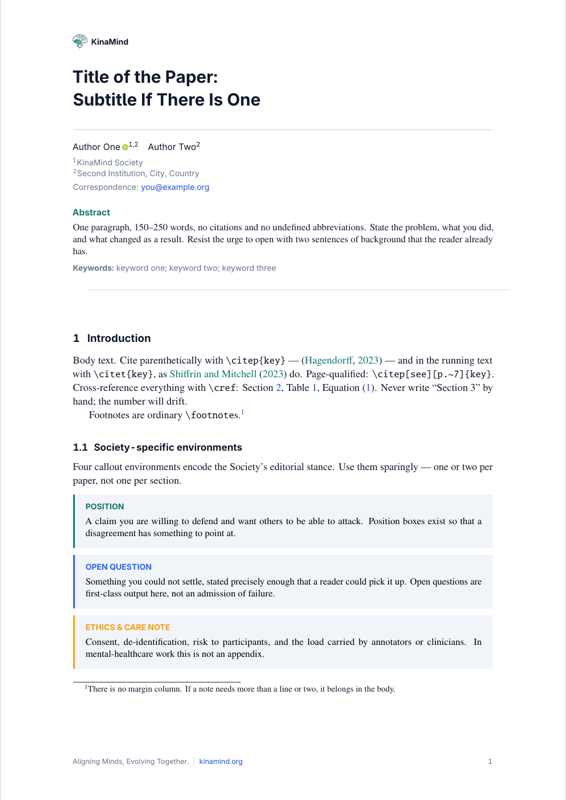
\documentclass[authoryear]{kinamind}

%% ---- Title -----------------------------------------------------------
%% Use \\ only where you genuinely want a line break (e.g. before a subtitle).
\title{Title of the Paper:\\ Subtitle If There Is One}

%% Running head, shown top-right from page 2 onwards. Keep it under ~60
%% characters. Omit and the full title is used, which usually wraps badly.
\shorttitle{Short Running Title}

%% ---- Authors and affiliations ----------------------------------------
%% Interface is authblk's: the optional argument is the affiliation mark.
%%   - one \author line per person, in author order
%%   - one \affil line per institution
%%   - \orcid{...} is optional and goes inside the author's name
%%   - single affiliation? drop the marks: \author{Name} + \affil{Institution}
%% Noetic (AI) contributors may be listed here as authors when the community
%% contribution policy warrants it; either way they must appear under
%% \noeticcontributions below.
\author[1,2]{Author One\orcid{0000-0002-1825-0097}}
\author[2]{Author Two}
\affil[1]{KinaMind Society}
\affil[2]{Second Institution, City, Country}

\correspondence{\href{mailto:you@example.org}{you@example.org}}

%% Semicolon-separated, lowercase unless a proper noun.
\keywords{keyword one; keyword two; keyword three}

%% ---- Optional metadata -----------------------------------------------
% \repo{github.com/kinamind/your-artefact}   % artefact / code repository
% \license{...}                              % adds a licence line to the
%                                            % first-page footer; the Society
%                                            % has not settled on one yet
% \venue{...}                                % PDF metadata only, not printed
% \homepage{https://kinamind.org}            % overrides the footer URL
% \tagline{...}  \logofile{...}  \nologo     % override the community mark

%% ---- Contribution statement (optional, encouraged) -------------------
%% Where a noetic (AI) system did substantive work, the Society would rather
%% see it named here than folded into the acknowledgements. Be specific:
%% what was generated, by which model and run, and who reviewed it.
%% Both commands are optional -- leave either out and its paragraph
%% disappears; leave out both and \contributions prints nothing.
\humancontributions{A.O. designed the study and wrote the manuscript.
A.T. ran the experiments and the statistical analysis.}
\noeticcontributions{Model \texttt{name-version} (run \texttt{id}) drafted
the counterfactual continuations in \cref{sec:method} and produced first-pass
labels, all reviewed by the human authors. Prompts, decoding parameters and
full logs are released with the artefact.}

\begin{document}
\maketitle

\begin{abstract}
One paragraph, 150--250 words, no citations and no undefined abbreviations.
State the problem, what you did, and what changed as a result. Resist the
urge to open with two sentences of background that the reader already has.
\end{abstract}

\section{Introduction}
\label{sec:intro}

Body text. Cite parenthetically with \verb|\citep{key}| ---
\citep{hagendorff2023machine} --- and in the running text with
\verb|\citet{key}|, as \citet{shiffrin2023probing} do. Page-qualified:
\verb|\citep[see][p.~7]{key}|. Cross-reference everything with
\verb|\cref|: \cref{sec:method}, \cref{tab:example}, \cref{eq:example}. Never
write ``Section~3'' by hand; the number will drift.

Footnotes are ordinary \verb|\footnote|s.\footnote{There is no margin
column. If a note needs more than a line or two, it belongs in the body.}

\subsection{Society-specific environments}

Four callout environments encode the Society's editorial stance. Use them
sparingly --- one or two per paper, not one per section.

\begin{position}
A claim you are willing to defend and want others to be able to attack.
Position boxes exist so that a disagreement has something to point at.
\end{position}

\begin{openquestion}
Something you could not settle, stated precisely enough that a reader could
pick it up. Open questions are first-class output here, not an admission
of failure.
\end{openquestion}

\begin{ethicsnote}
Consent, de-identification, risk to participants, and the load carried by
annotators or clinicians. In mental-healthcare work this is not an appendix.
\end{ethicsnote}

\begin{takeaway}
The one operational conclusion of a section, for a reader who is skimming.
\end{takeaway}

\subsection{Theorem-like environments}

Standard AMS set (\texttt{theorem}, \texttt{lemma}, \texttt{proposition},
\texttt{corollary}, \texttt{definition}, \texttt{remark}), plus
\texttt{hypothesis} and \texttt{construct}. The latter is for a
machine-psychology construct that must be defined before it can be measured.

\begin{construct}[Name of the construct]
\label{con:example}
An operational definition, stated so that two annotators could apply it to
the same material and disagree in a way you can adjudicate.
\end{construct}

\section{Method}
\label{sec:method}

Numbered equations get a label; unnumbered ones use \verb|\[ ... \]|.

\begin{equation}
\label{eq:example}
\kappa = \frac{p_o - p_e}{1 - p_e}.
\end{equation}

Define every symbol in the sentence that follows the equation, in the order
the symbols appear.

\subsection{Tables}

Use \texttt{booktabs} rules only --- \verb|\toprule|, \verb|\midrule|,
\verb|\bottomrule|. No vertical rules. Caption goes above the table.

\begin{table}[t]
\centering
\small
\caption{Caption above the table. One sentence saying what the reader should
notice, not a restatement of the column headers.}
\label{tab:example}
\begin{tabularx}{\linewidth}{@{}l r X@{}}
\toprule
\textbf{Condition} & \textbf{Score} & \textbf{Note} \\
\midrule
Baseline & 0.61 & \\
Ours     & 0.74 & Difference concentrated in the hard subset \\
\bottomrule
\end{tabularx}
\end{table}

\subsection{Figures}

Caption goes below the figure. Vector formats (PDF) for plots, PNG only for
screenshots and photographs. Keep figure text at or above 8\,pt at final
size --- do not scale a 12\,pt plot down to 40\%.

\begin{figure}[t]
\centering
% \includegraphics[width=0.8\linewidth]{assets/your-figure.pdf}
\fbox{\rule{0pt}{32mm}\rule{0.78\linewidth}{0pt}}
\caption{Caption below the figure. State the claim the figure supports.}
\label{fig:example}
\end{figure}

\section{Results}
\label{sec:results}

Report effect sizes and uncertainty, not only significance. Say where the
method fails; a paper with no negative result is usually a paper with an
unreported one.

\section{Conclusion}

What changed, what remains open, and what a reader should do next.

%% Contributions section (prints only if set above), then the bibliography.
%% The style is chosen by the class from the authoryear / numeric option --
%% do not add \bibliographystyle yourself.
\contributions
\bibliography{references}

\appendix
\section{Appendix Title}
\label{app:example}

Material that a determined reader needs and a normal reader does not:
prompts, hyperparameters, annotation guidelines, additional tables.

\end{document}
Preview

PDF Preview
Create an account to compile and preview