highlights_sample.texRead-only preview
%! TEX program = xelatex
\documentclass[testmode]{highlights}

\usepackage{siunitx}
\sisetup{per-mode=symbol}

\title{Highlights of \textit{Fundamentals of Microelectronics}}
\author{Jaeho Lee}
\date{\today}

\begin{document}
\maketitle

\section{Introduction to Microelectronics}
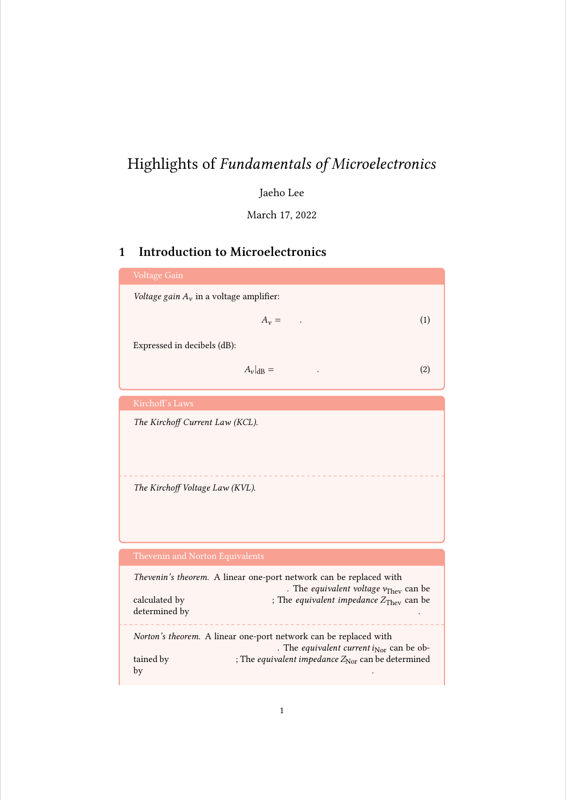
\begin{concept}{Voltage Gain}
  \emph{Voltage gain $A_v$} in a voltage amplifier:
  \begin{equation}
    A_v = \memorize{\frac{v_\mathrm{out}}{v_\mathrm{in}}}.
  \end{equation}
  Expressed in decibels (dB):
  \begin{equation}
    A_v|_{\mathrm{dB}} = \memorize{20 \log \frac{v_\mathrm{out}}{v_\mathrm{in}}}.
  \end{equation}
\end{concept}

\begin{concept}{Kirchoff's Laws}
  \emph{The Kirchoff Current Law (KCL).} \memorize{The sum of all currents flowing \emph{into} a node is zero:
  \begin{equation}
    \sum_j I_j = 0.
  \end{equation}}
  \tcbline
  \emph{The Kirchoff Voltage Law (KVL).} \memorize{The sum of voltage drops around any closed loop in a circuit is zero:
  \begin{equation}
    \sum_j V_j = 0.
  \end{equation}}
\end{concept}

\begin{concept}{Thevenin and Norton Equivalents}
  \emph{Thevenin's theorem.} A linear one-port network can be replaced with \memorize{a voltage source in series with an impedance}.
  The \emph{equivalent voltage $v_\mathrm{Thev}$} can be calculated by \memorize{leaving the port open};
  The \emph{equivalent impedance $Z_\mathrm{Thev}$} can be determined by \memorize{setting all independent voltage and current sources to zero}.
  \tcbline
  \emph{Norton's theorem.} A linear one-port network can be replaced with \memorize{a current source in parallel with an impedance}.
  The \emph{equivalent current $i_\mathrm{Nor}$} can be obtained by \memorize{shorting the port};
  The \emph{equivalent impedance $Z_\mathrm{Nor}$} can be determined by \memorize{setting all independent voltage and current sources to zero}.
  \tcbline
  Note that $Z_\mathrm{Thev} = Z_\mathrm{Nor}$.
\end{concept}

\section{Basic Physics of Semiconductors}
\begin{concept}{Bandgap Energy}
  The \emph{bandgap energy $E_g$} is \memorize{the minimum energy to dislodge an electron from a covalent bond}.
  This is a fundamental property of the material, e.g., for silicon $E_g = \memorize{\qty{1.12}{\eV}}$.
  ($\qty{1}{\eV} = \qty{1.6e-19}{\J}$)
\end{concept}

\begin{concept}{Electron Density (Charge Carrier Density)}
  The \emph{density of electrons $n_i$}, i.e., the number of electrons per unit volumn is
  \begin{equation}
    n_i = \memorize{\num{5.2e15} T^{\frac{3}{2}} \exp \frac{-E_g}{2kT} \unit[per-mode=power]{\per\cubic\cm}}.
  \end{equation}
  where $k = \qty{1.39e-23}{\J\per\K}$ is the Boltzmann constant.
\end{concept}
\end{document}
Preview

PDF Preview
Create an account to compile and preview