template.texRead-only preview
% Written by Bibby AI
\documentclass[a4paper]{article}

% Import packages.tex
\input{packages}

\begin{document}
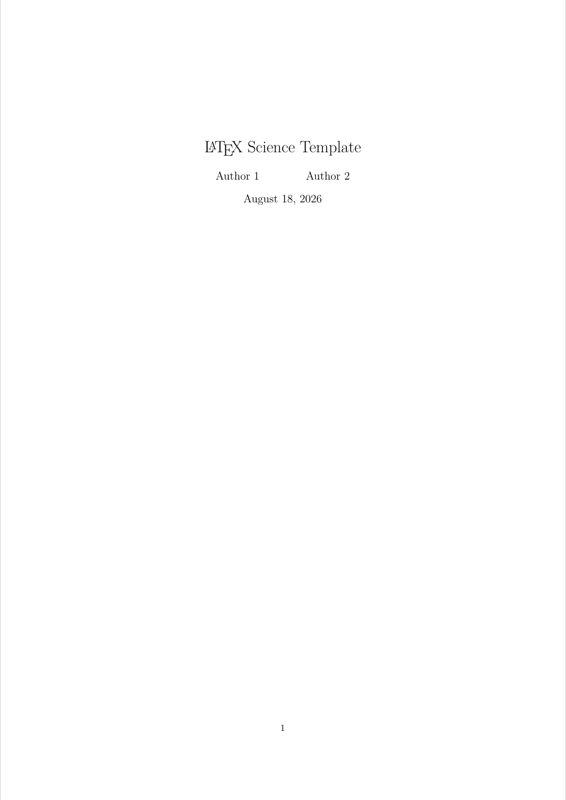
	\title{\LaTeX\ Science Template}
	\author{Author 1 \and Author 2}
	\maketitle

	\pagebreak

	\tableofcontents
	\pagebreak

	\section{Useful snippets}

	\subsection{Math}
	Let's write some random math.
	% Some math on a new line
	\[ \bigcup_{i=0}^{n} x_i \indent n \in \mathbb{N} \]
	And an aligned equation.
	% Aligned equation
	\begin{equation}
		\begin{split}
			P &= NP\\
			&\vee \\
			P&\neq NP
		\end{split}
	\end{equation}

	\subsection{Algorithm}
	\begin{algorithm}[H]
		$R:=\emptyset$\;
		$L(a):=0$\;
		$\forall v\neq a:L(v):=\infty$\;
		\While{$z\notin R$}{
			choose $v\in V\backslash R$ with lowest $L(v)$\;
			$R:=R\cup\{v\}$\;
			\ForEach{edge $(v,v')\in E$ with $v'\in V\backslash R$}{
				$L(v'):=min\{L(v)+w(v,v'),L(v')\}$
			}
		}
		\caption{Dijkstra's shortest path algorithm}
	\end{algorithm}

	\subsection{Definition \& proof}
	\begin{leftbar}
		\begin{definition}[Example definition]
			A definition, nicely wrapped by a \texttt{leftbar} environment.
		\end{definition}
	\end{leftbar}
	\begin{proof}
		Of course, we can't leave the proof out.
	\end{proof}

	\subsection{Figure}
	Let's see what \autoref{fig:plots} looks like. ``Figure 1" in the previous sentence is a clickable reference.
	% Using the H modifier from the float package to include the figure HERE.
	\begin{figure}[H]
		% Center figure
		\centering
		% Center caption
		\captionsetup{justification=centering}
		% The actual figure
		\includegraphics[scale=0.2]{assets/plots}
		% And a nice caption
		\caption{Example of including an image in a \LaTeX\ document, centered and positioned exactly where it's included in the code.\label{fig:plots}}
	\end{figure}
% Written by Bibby AI
\end{document}
Preview

PDF Preview
Create an account to compile and preview