paper.texRead-only preview
\documentclass{spectrum}

\title{Open-Source Community Is Skeptical of Arduino’s Sale}
\subtitle{But buyer Qualcomm says it's committed to open source}
\author{Matthew S.\ Smith}

\makeatletter
\typeout{TITLE BEFORE BEGIN = \meaning\@title}
\makeatother
\begin{document}
\makeatletter
\typeout{TITLE AFTER BEGIN = \meaning\@title}
\makeatother

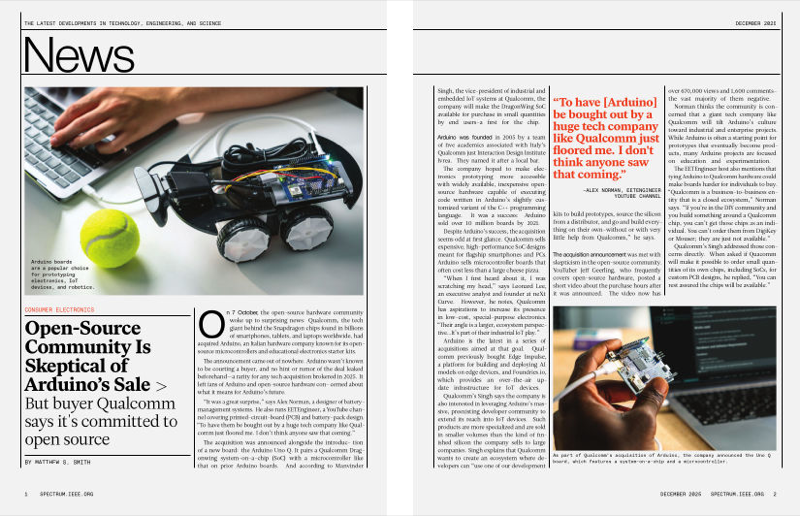
\firstletter{O}{n 7 October,} the open-source hardware community woke up to surprising news: Qualcomm, the tech giant behind the Snapdragon chips found in billions of smartphones, tablets, and laptops worldwide, had acquired Arduino, an Italian hardware company known for its open-source microcontrollers and educational electronics starter kits.

The announcement came out of nowhere. Arduino wasn’t known to be courting a buyer, and no hint or rumor of the deal leaked beforehand—a rarity for any tech acquisition brokered in 2025. It left fans of Arduino and open-source hardware con- cerned about what it means for Arduino’s future.

“It was a great surprise,” says Alex Norman, a designer of battery-management systems. He also runs EETEngineer, a YouTube channel covering printed-circuit-board (PCB) and battery-pack design. “To have them be bought out by a huge tech company like Qualcomm just floored me. I don’t think anyone saw that coming.”

\parfillskip=0pt
The acquisition was announced alongside the introduc- tion of a new board: the Arduino Uno Q. It pairs a Qualcomm Dragonwing system-on-a-chip (SoC) with a microcontroller like that on prior Arduino boards. And according to Manvinder

\framebreak

\parfillskip=10pt
\noindent Singh, the vice-president of industrial and embedded IoT systems at Qualcomm, the company will make the DragonWing SoC available for purchase in small quantities by end users--a first for the chip.

\vskip 10pt

\noindent {\lettrinefont\bfseries Arduino was founded} in 2005 by a team of five academics associated with Italy's Qualcomm just Interaction Design Institute Ivrea. They named it after a local bar.

The company hoped to make electronics prototyping more accessible with widely available, inexpensive open-source hardware capable of executing code written in Arduino's slightly customized variant of the C++ programming language. It was a success: Arduino sold over 10 million boards by 2021.

Despite Arduino's success, the acquisition seems odd at first glance. Qualcomm sells expensive, high-performance SoC designs meant for flagship smartphones and PCs. Arduino sells microcontroller boards that often cost less than a large cheese pizza.

“When I first heard about it, I was scratching my head,” says Leonard Lee, an executive analyst and founder at neXt Curve. However, he notes, Qualcomm has aspirations to increase its presence in low-cost, special-purpose electronics. “Their angle is a larger, ecosystem perspective\dots It's part of their industrial IoT play.”

Arduino is the latest in a series of acquisitions aimed at that goal. Qualcomm previously bought Edge Impulse, a platform for building and deploying AI models on edge devices, and Foundries.io, which provides an over-the-air update infrastructure for IoT devices.

Qualcomm's Singh says the company is also interested in leveraging Arduino's massive, preexisting developer community to extend its reach into IoT devices. Such products are more specialized and are sold in smaller volumes than the kind of finished silicon the company sells to large companies. Singh explains that Qualcomm wants to create an ecosystem where developers can “use one of our development kits to build prototypes, source the silicon from a distributor, and go and build everything on their own--without or with very little help from Qualcomm,” he says.

\vskip 10pt

\noindent {\lettrinefont\bfseries The acquisition announcement} was met with skepticism in the open-source community. YouTuber Jeff Geerling, who frequently covers open-source hardware, posted a short video about the purchase hours after it was announced.  The video now has over 670,000 views and 1,600 comments--the vast majority of them negative.

Norman thinks the community is concerned that a giant tech company like Qualcomm will tilt Arduino's culture toward industrial and enterprise projects. While Arduino is often a starting point for prototypes that eventually become prod- ucts, many Arduino projects are focused on education and experimentation.

The EETEngineer host also mentions that tying Arduino to Qualcomm hardware could make boards harder for individuals to buy. “Qualcomm is a business-to-business entity that is a closed ecosystem,” Norman says. “If you're in the DIY community and you build something around a Qualcomm chip, you can't get those chips as an indi- vidual. You can't order them from DigiKey or Mouser; they are just not available.”

Qualcomm's Singh addressed those concerns directly. When asked if Qua\-comm will make it possible to order small quantities of its own chips, including SoCs, for custom PCB designs, he replied, “You can rest assured the chips will be available.”

\end{document}
%% :wrap=soft:
Preview

PDF Preview
Create an account to compile and preview