hw.texRead-only preview
%% LyX 2.2.2 created this file.  For more info, see http://www.lyx.org/.
%% Do not edit unless you really know what you are doing.
\documentclass[english]{article}
\renewcommand{\ttdefault}{cmtt}
\usepackage[T1]{fontenc}
\usepackage[latin9]{inputenc}
\usepackage{geometry}
\geometry{verbose,tmargin=2cm,bmargin=2cm,lmargin=1cm,rmargin=1cm}
\setlength{\parskip}{\smallskipamount}
\setlength{\parindent}{0pt}
\usepackage{float}
\usepackage{units}
\usepackage{graphicx}
\usepackage{esint}

\makeatletter
%%%%%%%%%%%%%%%%%%%%%%%%%%%%%% User specified LaTeX commands.

\usepackage{fancyhdr}
\pagestyle{fancy}
\lhead{ME 585 Special Topics in Mech. Eng., Fall 2015}
\chead{C. �a\u{g}r\i{} �ZKAN}
\rhead{Assignment 2}
\rfoot{Yeditepe University}
\cfoot{\thepage}
\lfoot{Mechanical Engineering}
\usepackage{tikz}
\usepackage{pgfplots}
    % recommended as of Pgfplots 1.3:
\pgfplotsset{compat=newest}

\makeatother

\usepackage{babel}
\usepackage{listings}
\renewcommand{\lstlistingname}{Listing}

\begin{document}

\paragraph*{{\large{}Question Modification:}}

Since ID=XXXXXXX9X03 the coefficients are $a=3;\:b=0;\:c=9$

Therefore;

$y=f(t)=3t^{2}+9$ in interval of $0,1$

\section*{{\large{}Solution:}}

$T=1\rightarrow\omega=\nicefrac{2\pi}{T}=2\pi$

$a_{0}=\frac{2}{1}\int_{0}^{1}f(t)dt=2\int_{0}^{1}(3t^{2}+9)dt=2\left[t^{3}+9t\right]_{0}^{1}=20$

$a_{n}=\frac{2}{1}\int_{0}^{1}(3t^{2}+9)cos(n\omega t)$

$b_{n}=\frac{2}{1}\int_{0}^{1}(3t^{2}+9)sin(n\omega t)$

Maxima is used to integrate the $f(t)*cos(2\pi n)$ and $f(t)*sin(2\pi n)$
to get cosine and sine compliance. The commands are listed below.

\begin{lstlisting}[basicstyle={\small\ttfamily}]
ratsimp(integrate((3*t^2+9)*cos(w*t*n),t,0,1));
ratsimp(integrate((3*t^2+9)*sin(w*t*n),t,0,1));

\end{lstlisting}

\[
a_{n}=2\times\frac{6\cdot n\cdot w\cdot\mathrm{cos}\left(n\cdot w\right)+\left(12\cdot{{n}^{2}}\cdot{{w}^{2}}-6\right)\cdot\mathrm{sin}\left(n\cdot w\right)}{{{n}^{3}}\cdot{{w}^{3}}}
\]

\[
b_{n}=2\times\frac{-6+9\cdot{{n}^{2}}\cdot{{w}^{2}}+\left(6-12\cdot{{n}^{2}}\cdot{{w}^{2}}\right)\cdot\mathrm{cos}\left(n\cdot w\right)+6\cdot n\cdot w\cdot\mathrm{sin}\left(n\cdot w\right)}{{{n}^{3}}\cdot{{w}^{3}}}
\]

Therefore;

\[
y(t)=\frac{a_{0}}{2}+\sum_{n=1}^{100}a_{n}cos(\omega nt)+b_{n}sin(\omega nt)
\]

To simplify the output; $\pi$ is set to 3.14 therefore $\omega=6.28$
since $\omega=2\pi$

\[
y(t)=\frac{20}{2}+\sum_{n=1}^{100}a_{n}cos(6.28nt)+b_{n}sin(6.28nt)
\]

\begin{lstlisting}[numbers=left,numberstyle={\scriptsize},basicstyle={\small\ttfamily},breaklines=true]
sum((2*6*n*(2*3.14)*cos(n*(2*3.14))+(12*n^2*(2*3.14)^2-6)*sin(n*(2*3.14)))/(n^3*(2*3.14)^3)*cos((2*3.14)*n*t)+2*(-6+9*n^2*(2*3.14)^2+(6-12*n^2*(2*3.14)^2)*cos(n*(2*3.14))+6*n*(2*3.14)*sin(n*(2*3.14)))/(n^3*(2*3.14)^3)*sin((2*3.14)*t*n), n, 1, 100), simpsum;
\end{lstlisting}

\begin{figure}[H]
\begin{centering}
\includegraphics[width=0.5\textwidth]{../YuksekLisans/muzik/grafik1aa}
\par\end{centering}
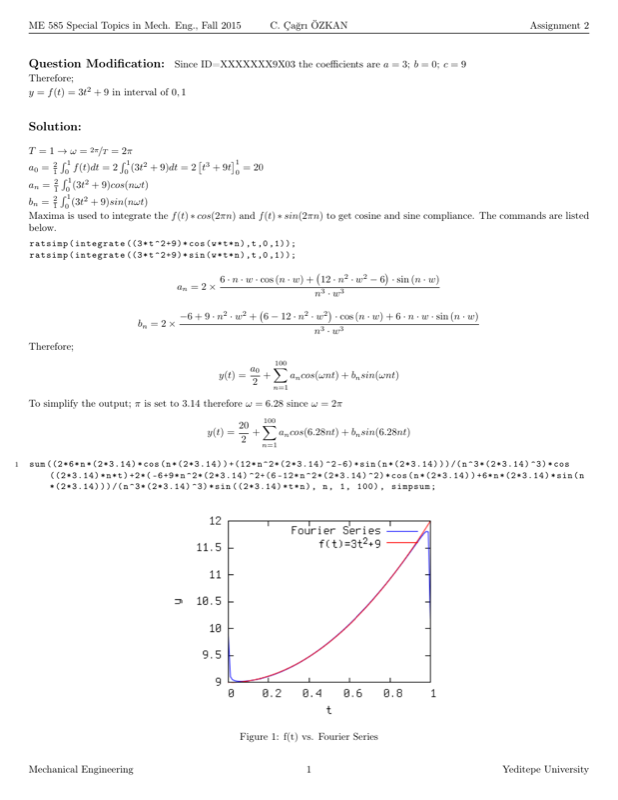
\caption{f(t) vs. Fourier Series}
\end{figure}

Following Octave code is used to determine intensity of each sine/cosine
component for the frequency from $\pi$ to $10\pi$

\begin{lstlisting}[numbers=left,numberstyle={\scriptsize},basicstyle={\small\ttfamily}]
function ycos=an(n)
  ycos=2*(6*n*2*pi*cos(n*2*pi)+(12*n^2*(2*pi)^2-6)*sin(n*2*pi))/(n^3*(2*pi)^3);

endfunction

function ysin=bn(n)
  ysin=2*(-6+9*n^2*(2*pi)^2+(6-12*n^2*(2*pi)^2)*cos(n*(2*pi))+6*n*(2*pi)*...
  sin(n*(2*pi)))/(n^3*(2*pi)^3);

endfunction


for i=1:1:10
  m(i,1)=sqrt(an(i)^2+bn(i)^2);
endfor


f1 = fopen('~/YuksekLisans/muzik/hw3_m.dat','w');
for i = 1:length(m)
    fprintf(f1,'%d\n',m(i));
end
fclose(f1);
\end{lstlisting}

\begin{figure}
\begin{centering}
\includegraphics[width=0.5\textwidth]{../YuksekLisans/muzik/22}
\par\end{centering}
\caption{Intensity vs. frequency}

\end{figure}

\end{document}
Preview

PDF Preview
Create an account to compile and preview