sample.texRead-only preview
\documentclass[a4paper, 11pt]{article}
\pdfoutput=1

% \usepackage{libertine}
\usepackage{tgtermes}
\usepackage{geometry}
\usepackage[round]{natbib}                      % For bibliography style
\renewcommand{\sfdefault}{lmss}  % Computer Modern Sans
\renewcommand{\bfdefault}{bx}
% \renewcommand{\ttdefault}{ccr}

\usepackage{hyperref}
\usepackage{xcolor}
\usepackage{natbib}
\usepackage{listings}
\usepackage{color}

\definecolor{codegreen}{rgb}{0,0.6,0}
\definecolor{codegray}{rgb}{0.5,0.5,0.5}
\definecolor{codepurple}{rgb}{0.58,0,0.82}
\definecolor{backcolour}{rgb}{0.85,0.85,0.92}

\lstdefinestyle{mystyle}{
    backgroundcolor=\color{backcolour},
    commentstyle=\color{codegreen},
    keywordstyle=\color{magenta},
    numberstyle=\tiny\color{codegray},
    stringstyle=\color{codepurple},
    basicstyle=\footnotesize\ttfamily,
    breakatwhitespace=false,
    breaklines=true,
    captionpos=b,
    keepspaces=true,
    numbers=left,
    numbersep=5pt,
    showspaces=false,
    showstringspaces=false,
    showtabs=false,
    tabsize=2
}
\lstset{style=mystyle}

\usepackage{titlesec}
\titleformat{\section}{\bfseries\sffamily\large}{\thesection}{1em}{}
\titleformat{\subsection}{\bfseries\sffamily}{\thesubsection}{0.5em}{}
\titleformat{\subsubsection}{\bfseries\sffamily}{\thesubsubsection}{0.4em}{}

\usepackage[acronym,smallcaps,nowarn,section,nonumberlist]{glossaries}
\glsdisablehyper{}

\usepackage{scalefnt,letltxmacro}
\LetLtxMacro{\oldtextsc}{\textsc}
\renewcommand{\textsc}[1]{\oldtextsc{\scalefont{1.10}#1}}

\newacronym{MDP}{mdp}{Markov decision process}
\newacronym{RL}{rl}{Reinforcement learning}
%----------------------------------------------------------------------------


\usepackage[alpha]{mdpn}   % Load the MDP notation style


%----------------------------------------------------------------------------
%   TITLE SECTION
%----------------------------------------------------------------------------
\author{Billy Okal\\\\
University of Freiburg}

\title{\bf \sffamily Example Usage of MDPNv1 Notation}
\date{}


\begin{document}

\maketitle


\section{Introduction}
\label{sec:intro}
Many \gls{RL} research papers contain paragraphs that define \gls{MDP} and related concepts~\cite[see][for detailed exposition]{SuttonBarto}.
These paragraphs take up space that could otherwise be used to present more useful/new content.
In this paper we demonstrate a package implementing a recently proposed notation\footnote{\url{http://arxiv.org/abs/1512.09075}} for \gls{MDP} that can be used as common foundation. Declaring the use this notation using a single sentence can replace several paragraphs of notational specifications in other papers.

\section{MDPs using MDPNv1 notation}
\label{sec:mdps}

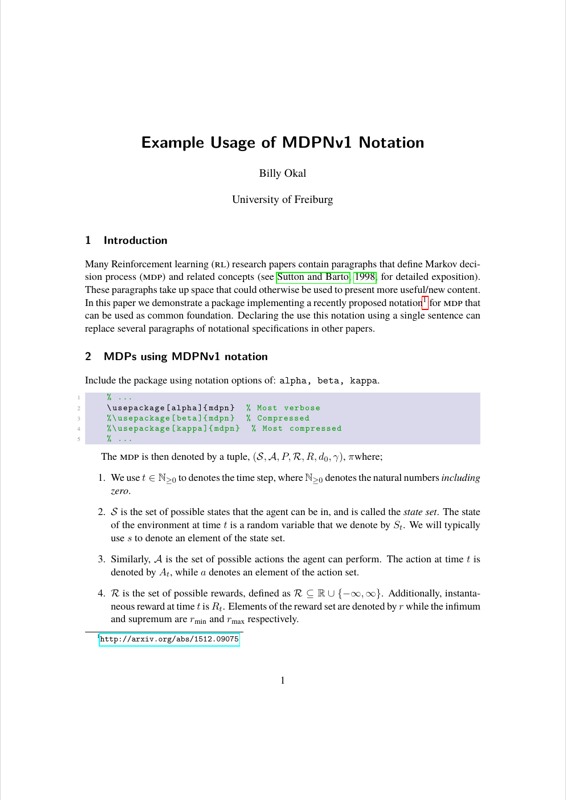
Include the package using notation options of: {\tt alpha, beta, kappa}.
\begin{lstlisting}[language=Tex]
    % ...
    \usepackage[alpha]{mdpn}  % Most verbose
    %\usepackage[beta]{mdpn}  % Compressed
    %\usepackage[kappa]{mdpn}  % Most compressed
    % ...
\end{lstlisting}

The \gls{MDP} is then denoted by a tuple, $\MDP$, $\p$where;
%
\begin{enumerate}
    \item We use $\step$ to denotes the time step, where $\NZ$ denotes the natural numbers {\em including zero}.

    \item $\sset$ is the set of possible states that the agent can be in, and is called the {\em state set}. The state of the environment at time $t$ is a random variable that we denote by $\st{t}$. We will typically use $s$ to denote an element of the state set.

    \item Similarly, $\aset$ is the set of possible actions the agent can perform. The action at time $t$ is denoted by $\at{t}$, while $a$ denotes an element of the action set.

    \item $\rset$ is the set of possible rewards, defined as $\rsetdef$. Additionally, instantaneous reward at time $t$ is $\Rfun_t$. Elements of the reward set are denoted by $r$ while the infimum and supremum are $\rmin$ and $\rmax$ respectively.

    \item $\Tdef$ is called the {\em transition function}. For all $(s,a,s',t) \in \sset \times \aset \times \sset \times \NZ$, let $\Tfun(s,a,s')\coloneqq\Pr(\st{t+1}=s' \mid \st{t}=s, \at{t}=a)$.
    That is, $\Tfun$ characterizes the distribution over states at time $t+1$ given the state and action at time $t$.
    We allow three alternate notations for $\Tfun$.
    \begin{enumerate}
        \item {\tt alpha}: $\T{s}{a}{s'} \coloneqq \Tfun(s,a,s')$.
    This form takes approximately the same amount of space, but makes it more clear that $\Tfun$ is a conditional distribution over the next state given the current state and action.
        \item {\tt beta}: $\Tfun_{s}^{a}(s') \coloneqq \Tfun(s,a,s')$.
    This notation moves terms into subscripts and superscripts in order to save some space.
        \item {\tt kappa}: $\Tfun_{s,s'}^{a} \coloneqq \Tfun(s,a,s')$.
    This final form is particularly useful when space is limited.
    \end{enumerate}
    Once the author selects one the three notations modes, consistent within each paper is ensured automatically.

    \item The reward function is denoted by $\Rfun$, and so on with three options provided.

    \item $\isset$ is the initial distribution of states defined as $\issetdef$.
    \item $\D$ is the discount factor defined as $\Ddef$.

\end{enumerate}
%

Further, $\p$ is the policy which is defined as $\pdef$ ...


\section{Acknowledgments}
\label{sec:thanks}
I want to thank Phillip Thomas for fruitful discussions on the naming and contents of this package.


%-----------------------------------------------------------------------------
%   REFERENCE LIST
%-----------------------------------------------------------------------------

\begin{thebibliography}{1}
\providecommand{\natexlab}[1]{#1}
\providecommand{\url}[1]{\texttt{#1}}
\expandafter\ifx\csname urlstyle\endcsname\relax
  \providecommand{\doi}[1]{doi: #1}\else
  \providecommand{\doi}{doi: \begingroup \urlstyle{rm}\Url}\fi

\bibitem[Sutton and Barto(1998)]{SuttonBarto}
R.~S. Sutton and A.~G. Barto.
\newblock \emph{Reinforcement Learning: {A}n Introduction}.
\newblock MIT Press, Cambridge, MA, 1998.

\end{thebibliography}
\bibliographystyle{abbrvnat}    % Uses author initials (requires abbrvnat.bst)

%-----------------------------------------------------------------------------

\end{document}
Preview

PDF Preview
Create an account to compile and preview