msca-pf-part-b1-template.texRead-only preview
% badness-ignore-file unreferenced-label
% badness-ignore-file hard-coded-reference

\documentclass[12pt,draftproposal]{msca-pf}

% {{{ packages

% better environments
\usepackage[nameinlink, noabbrev]{cleveref}
\usepackage{booktabs}
\usepackage{caption}
\usepackage{subcaption}

% better typography
\usepackage[activate={true,nocompatibility}, tracking=true]{microtype}

% }}}

% {{{ formatting

% NOTE: this needs to be kept so that the sections match the template!
\setcounter{section}{0}

% }}}

% {{{ commands

% add your own fancy commands
% \NewDocumentCommand \mycmd { m } {\textbf{#1}}

% }}}

% {{{ title

\title{Part B-1}
\author{}
\date{}

% NOTE: update these as necessary
% \mscaidentifier{HORIZON-MSCA-2026-PF-01}
% \mscaproject{TDB}

% }}}

\begin{document}

\maketitle

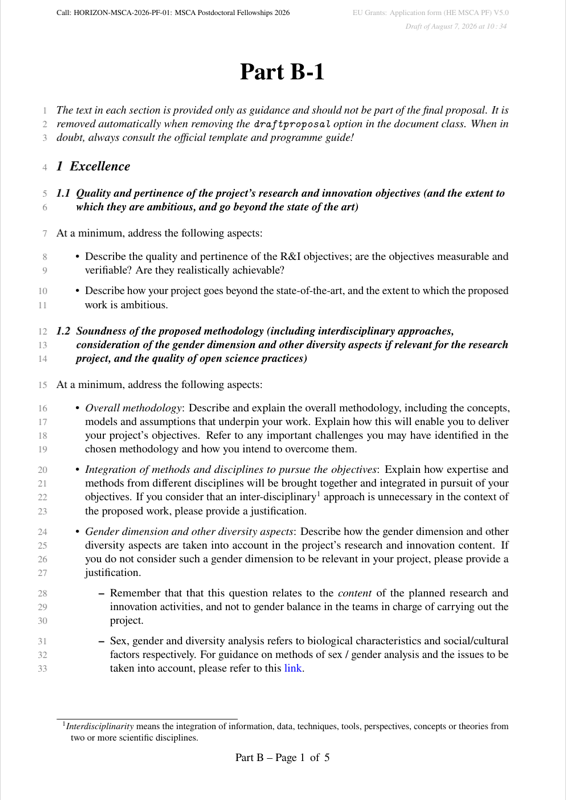
\begin{mscaexplanation}
\itshape The text in each section is provided only as guidance and should not be part of
the final proposal. It is removed automatically when removing the \texttt{draftproposal}
option in the document class. When in doubt, always consult the official template and
programme guide!
\end{mscaexplanation}

\section{Excellence}
\label{sc:excellence}

\subsection{Quality and pertinence of the project's research and innovation objectives
    (and the extent to which they are ambitious, and go beyond the state of the art)}
\label{ssc:excellence:quality}

\begin{mscaexplanation}
At a minimum, address the following aspects:

\begin{itemize}
    \item Describe the quality and pertinence of the R\&I objectives; are the
    objectives measurable and verifiable? Are they realistically achievable?

    \item Describe how your project goes beyond the state-of-the-art, and the
    extent to which the proposed work is ambitious.
\end{itemize}
\end{mscaexplanation}

\subsection{Soundness of the proposed methodology
    (including interdisciplinary approaches, consideration of the gender
    dimension and other diversity aspects if relevant for the research project,
    and the quality of open science practices)}
\label{ssc:excellence:methodology}

\begin{mscaexplanation}
At a minimum, address the following aspects:

\begin{itemize}
    \item \emph{Overall methodology}: Describe and explain the overall methodology,
    including the concepts, models and assumptions that underpin your work.
    Explain how this will enable you to deliver your project’s objectives. Refer
    to any important challenges you may have identified in the chosen methodology
    and how you intend to overcome them.

    \item \emph{Integration of methods and disciplines to pursue the objectives}:
    Explain how expertise and methods from different disciplines will be brought
    together and integrated in pursuit of your objectives. If you consider that
    an inter-disciplinary\footnotemark{} approach is unnecessary in the
    context of the proposed work, please provide a justification.

    \footnotetext{\emph{Interdisciplinarity} means the integration of information,
    data, techniques, tools, perspectives, concepts or theories from two or
    more scientific disciplines.}

    \item \emph{Gender dimension and other diversity aspects}: Describe how the
    gender dimension and other diversity aspects are taken into account in the
    project's research and innovation content. If you do not consider such a
    gender dimension to be relevant in your project, please provide a
    justification.
    \begin{itemize}
        \item Remember that that this question relates to the \emph{content} of the
        planned research and innovation activities, and not to gender balance
        in the teams in charge of carrying out the project.

        \item  Sex, gender and diversity analysis refers to biological
        characteristics and social/cultural factors respectively. For guidance on
        methods of sex / gender analysis and the issues to be taken into account,
        please refer to this
        \href{https://op.europa.eu/en/publication-detail/-/publication/33b4c99f-2e66-11eb-b27b-01aa75ed71a1/language-en}{link}.
    \end{itemize}

    \item \emph{Open science practices}: Describe how appropriate open science
    practices are implemented as an integral part of the proposed methodology.
    Show how the choice of practices and their implementation is adapted to the
    nature of your work in a way that will increase the chances of the project
    delivering on its objectives. If you believe that none of
    these practices are appropriate for your project, please provide a justification
    here.

    \emph{Open science is an approach based on open cooperative work and systematic
    sharing of knowledge and tools as early and widely as possible in the process.
    Open science practices include early and open sharing of research (for example
    through pre-registration, registered reports, pre-prints, or crowd-sourcing);
    research output management; measures to ensure reproducibility of research
    outputs; providing open access to research outputs (such as publications,
    data, software, models, algorithms, and workflows); participation in open
    peer-review; and involving all relevant knowledge actors including citizens,
    civil society and end users in the co-creation of R\&I agendas and contents
    (such as citizen science).}

    \emph{Please note that this does not refer to outreach actions that may be
    planned as part of the communication, dissemination and exploitation activities.
    These aspects should instead be described below under ``Impact''.}

    \item Proposals selected for funding under Horizon Europe will need to develop
    a detailed data management plan (DMP) for making their data/research outputs
    findable, accessible, interoperable and reusable (FAIR) as a deliverable by
    month 6 and revised towards the end of a project's lifetime. The DMP should
    describe how research outputs (especially research data) generated and/or
    collected during the project will be managed so as to ensure that they are
    findable, accessible, interoperable and reusable.

    \emph{For guidance on open science practices and research data management,
    please refer to the relevant section of the
    \href{https://ec.europa.eu/info/funding-tenders/opportunities/docs/2021-2027/horizon/temp-form/af/af_he-msca-pf_en.pdf}{HE Programme Guide}
    on the Funding \& Tenders Portal.}
\end{itemize}
\end{mscaexplanation}

\subsection{Quality of the supervision, training and of the two-way transfer of
    knowledge between the researcher and the host}
\label{ssc:excellence:supervision}

\begin{mscaexplanation}
At a minimum, address the following aspects:

\begin{itemize}
    \item Describe the qualifications and experience of the supervisor(s).
    Provide information regarding the supervisors' level of experience on the
    research topic proposed and their track record of work, including main
    international collaborations, as well as the level of experience in
    supervising/training, especially at advanced level (i.e.\ PhD and postdoctoral
    researchers).

    \item Planned training activities for the researcher (scientific aspects,
    management/organisation, horizontal and key transferable skills \dots).

    \item For \emph{European Fellowships}: two-way transfer of knowledge between
    the researcher and host organisation.

    \item For \emph{Global Fellowships}: three-way transfer of knowledge between
    the researcher, host organisation, and associated partner for outgoing phase.

    \item Rationale and added-value of the non-academic placement (if applicable)
    and secondment (if applicable).
\end{itemize}

Employers and/or funders should ensure that a person is clearly identified to
whom researchers can refer for the performance of their professional duties, and
should inform the researchers accordingly.

Such arrangements should clearly define that the proposed supervisors are
sufficiently expert in supervising research, have the time, knowledge, experience,
expertise and commitment to be able to offer the postdoctoral researcher
appropriate support and provide for the necessary progress and review procedures,
as well as the necessary feedback mechanisms.

\textbf{Supervision} is one of the crucial elements of successful research. Guiding,
supporting, directing, advising and mentoring are key factors for a researcher
to pursue his/her career path. In this context, all MSCA-funded projects are
encouraged to follow the recommendations outlined in the
\href{https://data.europa.eu/doi/10.2766/508311}{MSCA Guidelines on Supervision}.
\end{mscaexplanation}

\subsection{Quality and appropriateness of the researcher's professional
    experience, competences and skills}
\label{ssc:excellence:researcher}

\begin{mscaexplanation}
Discuss the quality and appropriateness of the researcher’s existing professional
experience in relation to the proposed research project.
\end{mscaexplanation}

\section{Impact}
\label{sc:impact}

\subsection{Credibility of the measures to enhance the career perspectives
    and employability of the researcher and contribution to his/her skills
    development}
\label{ssc:impact:career}

\begin{mscaexplanation}
At a minimum, address the following aspects:

\begin{itemize}
    \item Specific measures to enhance career perspectives and employability of
    the researcher inside and/or outside academia.
    \item \emph{Expected} contribution of proposed skills development to the
    future career of the researcher.
\end{itemize}
\end{mscaexplanation}

\subsection{Suitability and quality of the measures to maximise expected
    outcomes and impacts, as set out in the dissemination and exploitation plan,
    including communication activities}
\label{ssc:impact:outcomes}

\begin{mscaexplanation}
At a minimum, address the following aspects:

\begin{itemize}
    \item \emph{Plan for the dissemination and exploitation activities, including
    communication activities}\footnotemark{}: Describe the planned measures to
    maximize the impact of your project by providing a first version of your ‘plan
    for the dissemination and exploitation including communication activities’.
    Describe the dissemination, exploitation measures that are planned, and the target
    group(s) addressed (e.g.\ scientific community, end users, financial actors,
    public at large). Regarding communication measures and public engagement
    strategy, the aim is to inform and reach out to society and show the activities
    performed, and the use and the benefits the project will have for citizens.
    Activities must be strategically planned, with clear objectives, start at the
    outset and continue through the lifetime of the project. The description of
    the communication activities needs to state the main messages as well as the
    tools and channels that will be used to reach out to each of the chosen target
    groups.

    \footnotetext{In case your proposal is selected for funding, a more detailed
    Dissemination and Exploitation plan will need to be provided as a mandatory
    project deliverable during project implementation.}

    \item \emph{Strategy for the management of intellectual property, foreseen
    protection measures}: if relevant, discuss the strategy for the management
    of intellectual property, foreseen protection measures, such as patents,
    design rights, copyright, trade secrets, etc., and how these would be used
    to support exploitation.

    \item All measures should be proportionate to the scale of the project and
    should contain concrete actions to be implemented both during and after the
    end of the project.
\end{itemize}
\end{mscaexplanation}

\subsection{The magnitude and importance of the project’s contribution to the
    expected scientific, societal and economic impacts}
\label{ssc:impact:future}

\begin{mscaexplanation}
\begin{itemize}
    \item Provide a narrative explaining how the project’s results are expected
    to make a difference in terms of impact, beyond the immediate scope and
    duration of the project. The narrative should include the components below,
    tailored to your project.

    \item Be specific, referring to the effects of your project, and not R\&I
    in general in this field. State the target groups that would benefit.

    \item The impacts of your project may be:

    \begin{itemize}
        \item \emph{Scientific}: e.g.\ contributing to specific scientific advances,
        across and within disciplines, creating new knowledge, reinforcing
        scientific equipment and instruments, computing systems (i.e.\ research
        infrastructures);

        \item \emph{Economic/technological}: e.g.\ bringing new
        products, services, business processes to the market, increasing efficiency,
        decreasing costs, increasing profits, contributing to standards’ setting,
        etc.

        \item \emph{Societal}: e.g.\ decreasing CO2 emissions,
        decreasing avoidable mortality, improving policies and decision-making,
        raising consumer awareness.
    \end{itemize}

    \item Only include such outcomes and impacts where your project would make
    a significant and direct contribution. Avoid describing very tenuous links
    to wider impacts.

    \item Give an indication of the magnitude and importance of the project's
    contribution to the expected outcomes and impacts, should the project be
    successful. Provide credible quantified estimates where possible and meaningful.

    ``Magnitude'' refers to how widespread the outcomes and impacts are likely
    to be. For example, in terms of the size of the target group, or the
    proportion of that group, that should benefit over time.

    ``Importance'' refers to the value of those benefits. For example, number of
    additional healthy life years; efficiency savings in energy supply.
\end{itemize}
\end{mscaexplanation}

\section{Quality and Efficiency of the Implementation}
\label{sc:implementation}

\subsection{Quality and effectiveness of the work plan, assessment of risks and
    appropriateness of the effort assigned to work packages}
\label{ssc:implementation:workplan}

\begin{mscaexplanation}
At a minimum, address the following aspects:

\begin{itemize}
    \item Brief presentation of the overall structure of the work plan,
    including deliverables and milestones.

    \item Timing of the different work packages and their components;

    \item Mechanisms in place to assess and mitigate risks (of research and/or
    administrative nature).
\end{itemize}

A Gantt chart must be included and should indicate the proposed Work Packages
(WP), major deliverables, milestones, secondments, placements, if applicable.
This Gantt chart counts towards the 10-page limit.

The schedule in the Gantt chart should indicate the number of months elapsed
from the start of the action (Month 1, Month 2, etc.), but no actual dates.
\end{mscaexplanation}

\subsection{Quality and capacity of the host institutions and participating
organisations, including hosting arrangements}
\label{ssc:implementation:host}

\begin{mscaexplanation}
At a minimum, address the following aspects:

\begin{itemize}
    \item Hosting arrangements, including integration in the team/institution(s)
    and support services available to the researcher.

    \item Quality and capacity of the participating organisations, including
    infrastructure, logistics and facilities. Additional information should be
    outlined in Part B-2 Section 5 (``Capacity of the Participating Organisations'').
\end{itemize}

Note that for GF, both the quality and capacity of the outgoing Third Country
host and the return host should be outlined.
\end{mscaexplanation}

\subsection*{Associated partners linked to a beneficiary {\protect\footnotemark{}}}
\label{ssc:implementation:partners}

\begin{mscaexplanation}
If applicable, outline here the involvement of any 'associated partners linked
to a beneficiary' (in particular, the name of the entity, the type of link with
the beneficiary and the tasks to be carried out).

\footnotetext{See the definitions section of the MSCA Work Programme for
further information.}
\end{mscaexplanation}

\end{document}

% kate: default-dictionary en_GB;
Preview

PDF Preview
Create an account to compile and preview