Oleafly
The local-first AI assisted research workspace for scientific writing & publishing. Research, Write, Compile, Verify and Publish in LaTeX • Typst • Markdown • Git-native • Open Source • Desktop Performance
Category
Resume & CVLicense
Free to use (MIT)File
src-tauri/resources/templates/acm/main.tex
main.texRead-only preview
% Written by Bibby AI
\documentclass[sigconf,nonacm]{acmart}

\begin{document}

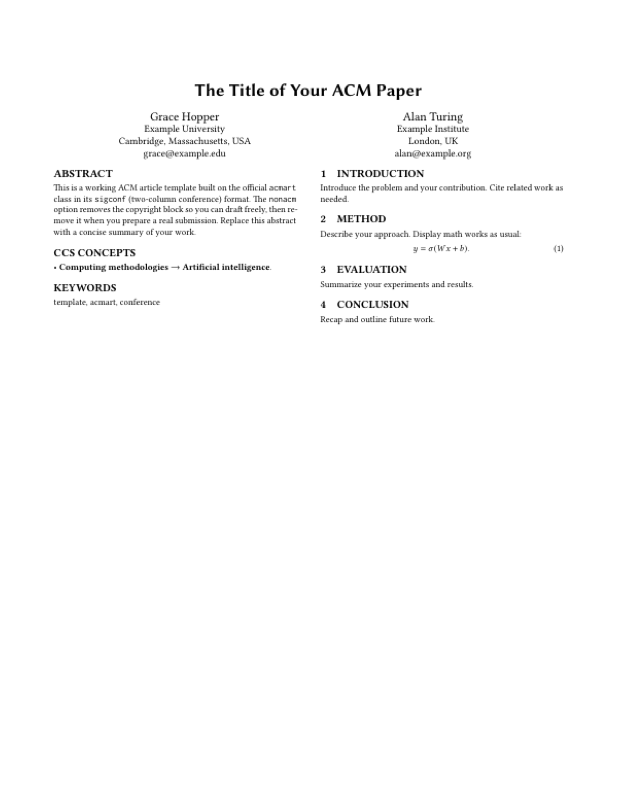
\title{The Title of Your ACM Paper}

\author{Grace Hopper}
\affiliation{%
  \institution{Example University}
  \city{Cambridge}
  \state{Massachusetts}
  \country{USA}}
\email{grace@example.edu}

\author{Alan Turing}
\affiliation{%
  \institution{Example Institute}
  \city{London}
  \country{UK}}
\email{alan@example.org}

\begin{abstract}
This is a working ACM article template built on the official \texttt{acmart}
class in its \texttt{sigconf} (two-column conference) format. The \texttt{nonacm}
option removes the copyright block so you can draft freely, then remove it when you
prepare a real submission. Replace this abstract with a concise summary of your
work.
\end{abstract}

\begin{CCSXML}
<ccs2012>
<concept>
<concept_id>10010147.10010178</concept_id>
<concept_desc>Computing methodologies~Artificial intelligence</concept_desc>
<concept_significance>500</concept_significance>
</concept>
</ccs2012>
\end{CCSXML}
\ccsdesc[500]{Computing methodologies~Artificial intelligence}

\keywords{template, acmart, conference}

\maketitle

\section{Introduction}
Introduce the problem and your contribution. Cite related work as needed.

\section{Method}
Describe your approach. Display math works as usual:
\begin{equation}
  y = \sigma(Wx + b).
\end{equation}

\section{Evaluation}
Summarize your experiments and results.

\section{Conclusion}
Recap and outline future work.

% Written by Bibby AI
\end{document}
Preview

PDF Preview
Create an account to compile and preview