main.texRead-only preview
% Written by Bibby AI
\pdfoutput=1
\documentclass[11pt,onecolumn]{cleantechnicalreport}

\usepackage[authoryear,sort&compress,round]{natbib}
\usepackage{hybridfrontmatter}

% The neutral base class remains responsible for XCharter text, newtxmath mathematics,
% zlmtt monospaced text, A4 geometry, body spacing, headings, and page furniture.

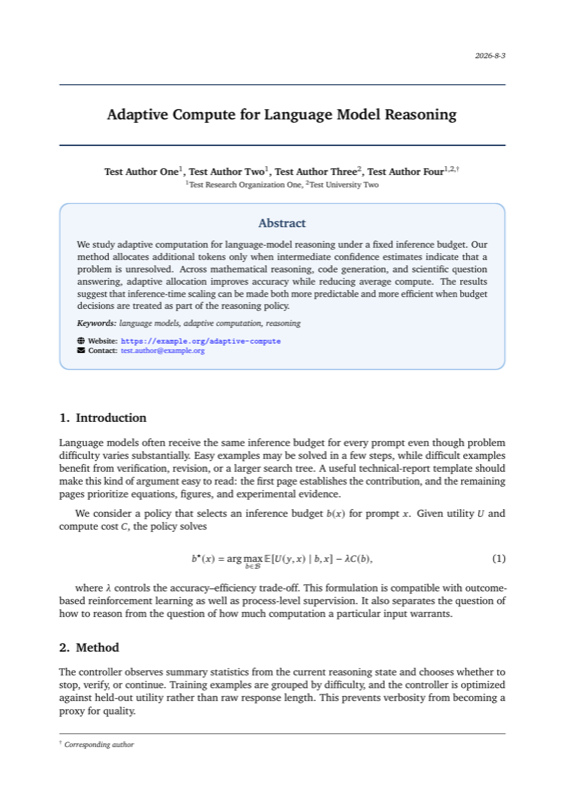
\title{Adaptive Compute for Language Model Reasoning}

\author[1]{Test Author One}
\author[1]{Test Author Two}
\author[2]{Test Author Three}
\author[1,2,$\dagger$]{Test Author Four}
\affil[1]{Test Research Organization One}
\affil[2]{Test University Two}
\renewcommand{\Authands}{, }

\reportauthornote{$^{\dagger}$ Corresponding author}
\reportwebsite{https://example.org/adaptive-compute}
\reportcontact{test.author@example.org}
\keywords{language models, adaptive computation, reasoning}

% Keep the abstract in the preamble: the base class captures it here and
% renders it when \maketitle is called. Do not put nested environments inside.
\begin{abstract}
We study adaptive computation for language-model reasoning under a fixed
inference budget. Our method allocates additional tokens only when intermediate
confidence estimates indicate that a problem is unresolved. Across mathematical
reasoning, code generation, and scientific question answering, adaptive
allocation improves accuracy while reducing average compute. The results suggest
that inference-time scaling can be made both more predictable and more efficient
when budget decisions are treated as part of the reasoning policy.
\end{abstract}

\begin{document}

\maketitle

\section{Introduction}

Language models often receive the same inference budget for every prompt even
though problem difficulty varies substantially. Easy examples may be solved in a
few steps, while difficult examples benefit from verification, revision, or a
larger search tree. A useful technical-report template should make this kind of
argument easy to read: the first page establishes the contribution, and the
remaining pages prioritize equations, figures, and experimental evidence.

We consider a policy that selects an inference budget $b(x)$ for prompt $x$.
Given utility $U$ and compute cost $C$, the policy solves

\begin{equation}
  b^{\star}(x)
  = \arg\max_{b \in \mathcal{B}}
    \mathbb{E}\!\left[U(y,x) \mid b,x\right] - \lambda C(b),
  \label{eq:budget-policy}
\end{equation}

where $\lambda$ controls the accuracy--efficiency trade-off. This formulation is
compatible with outcome-based reinforcement learning as well as process-level
supervision. It also separates the question of how to reason from the question
of how much computation a particular input warrants.

\section{Method}

The controller observes summary statistics from the current reasoning state and
chooses whether to stop, verify, or continue. Training examples are grouped by
difficulty, and the controller is optimized against held-out utility rather than
raw response length. This prevents verbosity from becoming a proxy for quality.

\subsection{Budget controller}

At decision step $t$, the controller receives state $s_t$ and samples action
$a_t \in \{\text{stop},\text{verify},\text{continue}\}$. The return combines task
reward with a linear token penalty. A clipped policy update limits abrupt changes
in allocation behavior, while an independent value head estimates the remaining
benefit of additional computation.

\begin{table}[t]
  \centering
  \caption{Illustrative accuracy and token usage. Lower token counts are better.}
  \label{tab:results}
  \begin{tabular}{lrr}
    \toprule
    Method & Accuracy (\%) & Mean tokens \\
    \midrule
    Fixed short budget & 71.4 & 512 \\
    Fixed long budget  & 78.2 & 2048 \\
    Adaptive budget    & \textbf{79.0} & \textbf{936} \\
    \bottomrule
  \end{tabular}
\end{table}

The example in Table~\ref{tab:results} illustrates the desired operating point:
adaptive allocation approaches the quality of a long fixed budget while using
less than half as many tokens. The values are placeholders and are included only
to demonstrate the inherited table and caption typography.

\section{Relationship to prior work}

The placeholder bibliography demonstrates author--year citations for scaling
and compute-allocation studies \citep{test2024scaling,test2025training}. Our
focus is complementary: the trained model is held fixed while computation is
allocated dynamically at inference time. A separate synthetic entry illustrates
how an architecture reference appears in the template \citep{test2023attention}.

\section{Conclusion}

This sample demonstrates the intended division of responsibility. The neutral
base class supplies the type system, mathematical fonts, page geometry,
paragraph rhythm, section hierarchy, captions, and later-page headers. The
companion package changes only the title composition and abstract presentation,
using the same XCharter family throughout.

\bibliographystyle{plainnat}
\bibliography{references}

% Written by Bibby AI
\end{document}
Preview

PDF Preview
Create an account to compile and preview