prettymath-example.texRead-only preview
\documentclass[11pt,a4paper]{article}
\usepackage[margin=1.5in]{geometry}
\usepackage{prettymath}
\setlength{\parskip}{0.8em}
\setlength{\parindent}{0em}

\title{Sample notes using the prettymath package}
\author{Radu Briciu}
\date{\today}


\begin{document}

\pagenumbering{roman}
\begin{titlepage}
	\vfill
	\begin{center}
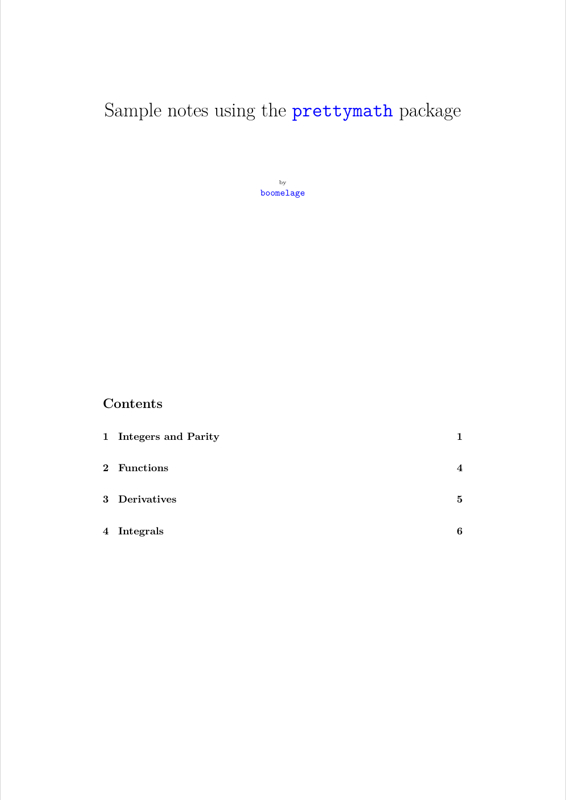
		\huge{Sample notes using the \href{https://github.com/boomelage/prettymath/blob/e4b6f0a6f1508e82686c20fdde10e6ff6c494d7f/prettymath.sty}{\texttt{prettymath}} package} \\
		\vspace{3em}
		\tiny by \\
		\small \href{https://github.com/boomelage}{\texttt{boomelage}}
	\end{center}
	\vfill
	\tableofcontents
	\vfill
\end{titlepage}

\clearpage
\pagenumbering{arabic}

\section{Integers and Parity}

In these notes we demonstrate the environments using elementary concepts. We refer to Definition~\ref{def:even}, Lemma~\ref{lem:even-square}, Theorem~\ref{thm:parity}, Proposition~\ref{prop:divides}, Corollary~\ref{cor:even-square-by-4}, Claim~\ref{clm:odd-plus-odd}, and Exercise~\ref{ex:odd-product}.

% tcbtheorem environments require a (possibly empty) title argument {}
\begin{definition}{}{even}
An integer $n$ is \emph{even} if there exists $k\in \mathbb{Z}$ with $n=2k$. An integer is \emph{odd} if there exists $k\in\mathbb{Z}$ with $n=2k+1$.
\end{definition}
In plain terms, an integer is even when it can be written as two times another integer, and it is odd when it can be written as two times an integer plus one.

\begin{example}{}{even-ex}
The integers $4$, $-6$, and $0$ are even; $3$ and $7$ are odd.
\end{example}
Said informally, four, negative six, and zero behave like even numbers, while three and seven behave like odd numbers.

\begin{example}{}{even-ex-2}
Since $12=2\cdot6$ and $-8=2\cdot(-4)$, both $12$ and $-8$ are even. Conversely, $5$ is not even because it cannot be written as $2k$ for any integer $k$.
\end{example}
Put differently, twelve and negative eight each equal two times another integer, whereas five fails to fit that even-number pattern.

A lemma is a proven statement that serves as a supporting result for subsequent arguments.
\begin{lemma}{}{even-square}
If $n$ is even, then $n^2$ is even.
\end{lemma}
This tells us that whenever a number is even, its square will also be even.

\begin{proofbox}{}{}
Write $n=2k$ for some $k\in\mathbb{Z}$. Then $n^2=(2k)^2=4k^2=2\,(2k^2)$, which is even.
\end{proofbox}
In words, by expressing the original number as two times an integer and then squaring, we see the result still contains a factor of two, so the square remains even.

A claim is an assertion we intend to justify, usually as part of a broader argument.
\begin{claim}{}{odd-plus-odd}
The sum of two odd integers is even.
\end{claim}
That is, adding one odd number to another odd number always gives an even number.

\begin{proofbox}{}{}
Let $a=2r+1$ and $b=2s+1$ with $r,s\in\mathbb{Z}$. Then $a+b=2(r+s+1)$ is even.
\end{proofbox}
The reasoning is that each odd number looks like two times an integer plus one, and when you add two such expressions the two extra ones combine into another factor of two, so the total is even.

A theorem is a central mathematical statement established from axioms and previously proven results.
\begin{theorem}{}{parity}
For integers $a$ and $b$:
\begin{itemize}
  \item even $+$ even $=$ even,
  \item even $+$ odd $=$ odd,
  \item odd $+$ odd $=$ even.
\end{itemize}
\end{theorem}
In everyday language, adding two even numbers keeps the result even, mixing an even with an odd yields an odd sum, and combining two odd numbers produces an even sum.

\begin{proofbox}{}{}
Write $a$ and $b$ as $2r$ or $2r+1$ and add; each case follows immediately. The final case is exactly Claim~\ref{clm:odd-plus-odd}.
\end{proofbox}
The proof simply rewrites each number as either two times an integer or two times an integer plus one, checks each combination, and notes that the odd plus odd case has already been justified.

A proposition is a true statement that is important but typically less prominent than a theorem.
\begin{proposition}{}{divides}
If $a\mid b$ and $b\mid c$ for integers $a,b,c$, then $a\mid c$.
\end{proposition}
This says that if one integer divides a second and that second divides a third, then the first also divides the third.

\begin{proofbox}{}{}
There exist $m,n\in\mathbb{Z}$ with $b=am$ and $c=bn$. Then $c=(am)n=a(mn)$, so $a\mid c$.
\end{proofbox}
In words, because the middle number equals the first times some integer and the last equals the middle times another integer, the last can be rewritten as the first times both integers together, so the divisibility passes through.

A corollary is a result that follows directly from a previously established theorem or proposition.
\begin{corollary}{}{even-square-by-4}
If $n$ is even, then $n^2$ is divisible by $4$.
\end{corollary}
This observation notes that every even number has a square that can be split evenly into four parts.

\begin{proofbox}{}{}
By Lemma~\ref{lem:even-square} write $n=2k$. Then $n^2=4k^2$, a multiple of $4$.
\end{proofbox}
The justification rewrites the original number as two times an integer, squares it, and sees that the result contains two factors of two, guaranteeing divisibility by four.

A remark records an ancillary observation or clarification that complements the main discussion.
\begin{remark}
From Definition~\ref{def:even}, every integer is exactly one of even or odd.
\end{remark}
In short, each whole number is either even or odd and never both.

\subsection*{Exercises: Integers and Parity}

\begin{exercise}{}{odd-product}
Show that the product of two odd integers is odd.
\end{exercise}

\begin{exercisesolution}{odd-product}
Let $a=2r+1$ and $b=2s+1$. Then
\[
ab=(2r+1)(2s+1)=4rs+2r+2s+1=2\bigl(2rs+r+s\bigr)+1,
\]
which is odd.
\end{exercisesolution}
The solution writes each odd number as two times an integer plus one, multiplies them, and observes that the result still has the form of two times an integer plus one, so it stays odd.

\section{Functions}

A function formalizes the idea of assigning exactly one output to each input.
\begin{definition}{}{function}
Let $A$ and $B$ be nonempty sets. A \emph{function} $f$ from $A$ to $B$, written $f\colon A\to B$, is a rule that assigns to every element $a\in A$ exactly one element $f(a)\in B$. The set $A$ is the \emph{domain} and the set $B$ is the \emph{codomain}.
\end{definition}
In plainer language, $f\colon A\to B$ means ``for each element of $A$ there is a well-defined output living in $B$,'' and no input is left without an output or matched to more than one.

\begin{example}{}{function-square}
Define $f\colon \mathbb{R}\to \mathbb{R}$ by $f(x)=x^2+1$. For each real number $x$, the output $f(x)$ is the real number obtained by squaring $x$ and adding $1$.
\end{example}
Here $\mathbb{R}$ denotes the set of all real numbers. The expression $x^2$ means $x$ multiplied by itself, and the formula $x^2+1$ says we then add $1$ to that product.

\begin{example}{}{function-table}
Let $A=\{1,2,3\}$ and $B=\{\text{red},\text{blue},\text{green}\}$. The rule $f(1)=\text{red}$, $f(2)=\text{green}$, $f(3)=\text{blue}$ defines a function $f\colon A\to B$.
\end{example}
Because every element of $A$ is assigned exactly one color from $B$, this rule satisfies the definition of a function.

\subsection*{Exercises: Functions}

\begin{exercise}{}{function-exercise}
Let $g\colon \mathbb{Z}\to \mathbb{Z}$ be defined by $g(n)=3n-4$. Determine $g(-2)$ and decide whether $g$ is a function.
\end{exercise}

\begin{exercisesolution}{function-exercise}
Substituting $n=-2$ gives $g(-2)=3(-2)-4=-6-4=-10$. The rule $3n-4$ produces exactly one integer output for each integer input, so $g$ is a function from $\mathbb{Z}$ to $\mathbb{Z}$.
\end{exercisesolution}
The notation $\mathbb{Z}$ stands for the set of all integers, and the expression $3n-4$ means ``triple the input $n$ and subtract four.''

\section{Derivatives}

\begin{definition}{}{derivative}
Let $f\colon \mathbb{R}\to \mathbb{R}$ be a function and let $a\in\mathbb{R}$. The \emph{derivative} of $f$ at $a$, denoted $f'(a)$, is the limit
\[
f'(a)=\lim_{h\to 0}\frac{f(a+h)-f(a)}{h}
\]
provided this limit exists. The symbol $\lim_{h\to 0}$ means we observe the ratio as $h$ approaches $0$, and the quotient measures the average rate of change over the small increment $h$.
\end{definition}
In everyday terms, the derivative captures how quickly $f$ changes near $a$; it is the slope of the tangent line to the graph of $f$ at the point with $x$-coordinate $a$.

\begin{example}{}{derivative-square}
Consider $f(x)=x^2$. Then
\[
f'(a)=\lim_{h\to 0}\frac{(a+h)^2-a^2}{h}=\lim_{h\to 0}\frac{2ah+h^2}{h}=\lim_{h\to 0}(2a+h)=2a.
\]
\end{example}
The algebra expands $(a+h)^2$ into $a^2+2ah+h^2$, subtracts $a^2$, and then divides by $h$. As $h$ shrinks toward $0$, the remaining term $h$ vanishes, leaving the slope $2a$.

\begin{example}{}{derivative-sine}
Let $f(x)=\sin x$, where $\sin x$ denotes the sine of the real number $x$ measured in radians. Using the standard limit $\lim_{h\to 0}\frac{\sin h}{h}=1$ and the identity $\sin(a+h)=\sin a\cos h+\cos a\sin h$, one finds $f'(a)=\cos a$.
\end{example}
This computation captures the rate at which the sine function oscillates, and it shows that the cosine function gives the instantaneous slope of the sine curve.

\subsection*{Exercises: Derivatives}

\begin{exercise}{}{derivative-exercise}
Let $f(x)=3x^3-5x$. Compute $f'(x)$ and evaluate $f'(1)$.
\end{exercise}

\begin{exercisesolution}{derivative-exercise}
Differentiate term by term: $\frac{d}{dx}(3x^3)=9x^2$ and $\frac{d}{dx}(-5x)=-5$. Thus $f'(x)=9x^2-5$, and substituting $x=1$ yields $f'(1)=9(1)^2-5=4$.
\end{exercisesolution}
Here $\frac{d}{dx}$ denotes the derivative with respect to $x$, and $x^3$ means $x$ multiplied by itself three times.

\section{Integrals}

\begin{definition}{}{integral}
Let $f\colon [a,b]\to \mathbb{R}$ be a bounded function, where $[a,b]=\{x\in\mathbb{R}\mid a\le x\le b\}$. The \emph{definite integral} of $f$ from $a$ to $b$ is the limit
\[
\int_a^b f(x)\,dx=\lim_{n\to\infty}\sum_{k=1}^{n} f(x_k^*)\Delta x,
\]
when this limit exists. Here the interval $[a,b]$ is subdivided into $n$ pieces of width $\Delta x=\frac{b-a}{n}$, and $x_k^*$ is a sample point in the $k$th subinterval.
\end{definition}
Informally, $\int_a^b f(x)\,dx$ adds up the values of $f$ across the interval $[a,b]$, multiplying each value by a very small width $\Delta x$. The result represents the signed area under the graph of $f$ between $x=a$ and $x=b$.

\begin{example}{}{integral-square}
Compute $\int_0^1 x^2\,dx$. Using the antiderivative $\frac{x^3}{3}$ we obtain
\[
\int_0^1 x^2\,dx=\left.\frac{x^3}{3}\right|_{0}^{1}=\frac{1^3}{3}-\frac{0^3}{3}=\frac{1}{3}.
\]
\end{example}
The vertical bar notation $\left.\frac{x^3}{3}\right|_{0}^{1}$ means evaluate $\frac{x^3}{3}$ at $x=1$ and subtract its value at $x=0$.

\begin{example}{}{integral-sine}
Using the antiderivative $-\cos x$ of $\sin x$, evaluate $\int_{0}^{\pi}\sin x\,dx$:
\[
\int_{0}^{\pi}\sin x\,dx=\left.-\cos x\right|_{0}^{\pi}=-\cos \pi-(-\cos 0)=(-(-1))-(-1)=2.
\]
\end{example}
The symbol $\pi$ denotes the constant approximately equal to $3.14159$, and $\cos x$ is the cosine function. The calculation shows the total signed area under one half-wave of the sine curve equals $2$.

\subsection*{Exercises: Integrals}

\begin{exercise}{}{integral-exercise}
Evaluate $\int_{1}^{4} \frac{1}{\sqrt{x}}\,dx$, where $\sqrt{x}$ denotes the positive square root of $x$.
\end{exercise}

\begin{exercisesolution}{integral-exercise}
Rewrite $\frac{1}{\sqrt{x}}$ as $x^{-1/2}$. An antiderivative is $\frac{x^{1/2}}{1/2}=2\sqrt{x}$. Therefore
\[
\int_{1}^{4} \frac{1}{\sqrt{x}}\,dx=\left.2\sqrt{x}\right|_{1}^{4}=2\sqrt{4}-2\sqrt{1}=2\cdot 2-2\cdot 1=2.
\]
\end{exercisesolution}~\label{integral-solution}
Because $\sqrt{4}=2$ and $\sqrt{1}=1$, the integral evaluates to $2$. The notation $x^{-1/2}$ means $\frac{1}{x^{1/2}}=\frac{1}{\sqrt{x}}$.

\end{document}
Preview

PDF Preview
Create an account to compile and preview