egyptian.texRead-only preview
\documentclass[ngerman,a4paper,11pt]{article}
\usepackage[scaled]{helvet}
\usepackage{txfonts}
\usepackage{mathptmx}
\usepackage[T1]{fontenc}
\usepackage{moodle}
\usepackage[margin=2cm]{geometry}
\usepackage{python}
\usepackage{graphicx}
\begin{document}
\begin{quiz}{Egyptian Calculations}
\begin{python}
def egyptian(c,d):
i=1
j=2
L=[]
K=[]
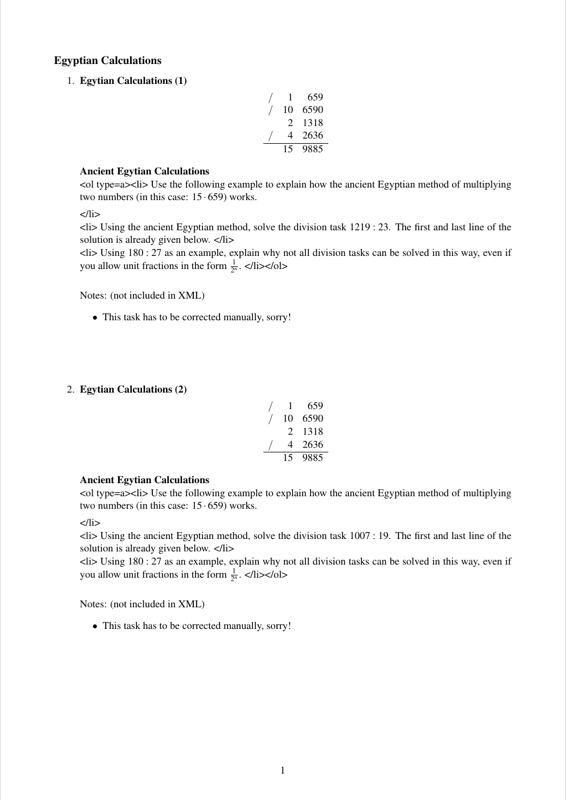
print(r"$$\begin{array}{rrr}")
a=c
b=d
rest1=a
zeile=0
while i<=a:
L.append([i,i*b,zeile])
rest1-=i
i=10*i
zeile+=1
while j-1<=rest1:
L.append([j,j*b,zeile])
j=2*j
rest=rest1
zeile+=1
rest=a
L.sort(key=lambda x: int(x[0]))
for i in range(0,len(L)):
if rest>=L[len(L)-1-i][0]:
z=L[len(L)-1-i][0]
L[len(L)-1-i][0]='/ &'+str(L[len(L)-1-i][0])
rest=rest-z
else:
L[len(L)-1-i][0]=' & '+str(L[len(L)-1-i][0])
L.sort(key=lambda x: int(x[2]))
for i in range(0,len(L)):
print(L[i][0],' & ',L[i][1],r"\\")
if (L[i][0]).find('/')!=-1:
K.append(L[i][1])
print("\hline")
print(" &",a," & ",sum(K))
print(r"\end{array}$$ ")
return('')
auswahl1=[[659,15],[479,18]]
auswahl2=[
[1219,23],[1007,19],[1127,23],[1073,37]]
c=0
for y in auswahl1:
for x in auswahl2:
c+=1
print(r"\begin{essay}[points=6, response format=html, response field lines=20, template={<h2>Part a.):</h2><p>","<span style=\"font-size: medium;\">",r"(Write down your solution here)<br><br></span></p><h2>Part b.):</h2>","<p><span style=\"font-family: \'courier new\', courier, monospace; font-size: medium;\">/1 ",x[1],"<br>(Write down the intermediate steps here)<br>--------<br> ",x[0]//x[1]," ",x[0],r"</span></p><h2>Part c.):</h2><p>","<span style=\"font-size: medium;\">",r"(Write down your solution here)<br><br></span></p>}]{Egytian Calculations (",c,r")}",sep='')
print(rf"""
\textbf{{Ancient Egytian Calculations}}\\<ol type=a><li>
Use the following example to explain how the ancient Egyptian method of multiplying two numbers (in this case: ${y[1]}\cdot{y[0]}$) works.
{egyptian(y[1],y[0])}
</li>\\
<li>
Using the ancient Egyptian method, solve the division task ${x[0]}:{x[1]}$.
The first and last line of the solution is already given below.
</li>\\
<li>
Using $180:27$ as an example, explain why not all division tasks can be solved in this way, even if you allow unit fractions in the form $\frac{{1}}{{2^n}}$.
</li></ol>\\
\item This task has to be corrected manually, sorry!
\end{{essay}}""")
if c%2==0 and c<8:
print(r"\newpage")
else:
print(r" \bigskip \,\\ \medskip ")
\end{python}
\end{quiz}
% --- The following python script is necessary to replace quotation marks, which could not be written directly --- %
% --- For importing into moodle, please make sure to use the -ready version of the xml-file --- %
\begin{python}
with open("egyptian-moodle.xml", "rt") as fin:
with open("egyptian-moodle-ready.xml", "wt") as fout:
for line in fin:
fout.write(line.replace('”', '\"').replace('’', '\''))
\end{python}
\end{document}
\end{document}
Preview

PDF Preview
Create an account to compile and preview