acad-few.texRead-only preview
% Written by Bibby AI
\documentclass[11pt]{article}

\usepackage{scholax}
\usepackage[margin=1in,a4paper]{geometry}
\setcounter{secnumdepth}{0}
\usepackage{microtype}

\usepackage{enumitem}
\setlist[itemize]{nosep,left=0pt..1.5em}
\setlist[enumerate]{leftmargin=*,labelsep=\parindent,label=[{\arabic*}]}

\usepackage{titlesec}
% \titlespacing{\section}{0pt}{*4}{*1}
\titlespacing{\subsection}{0pt}{*2.5}{-\parskip}
\titlespacing{\subsubsection}{0pt}{*0}{*0}
\titleformat{\section}{\large\bfseries\uppercase}{}{}{}[\titlerule]
\titleformat*{\subsection}{\large\bfseries}
\titleformat*{\subsubsection}{\bfseries\itshape}

\usepackage{bibentry}


\begin{document}

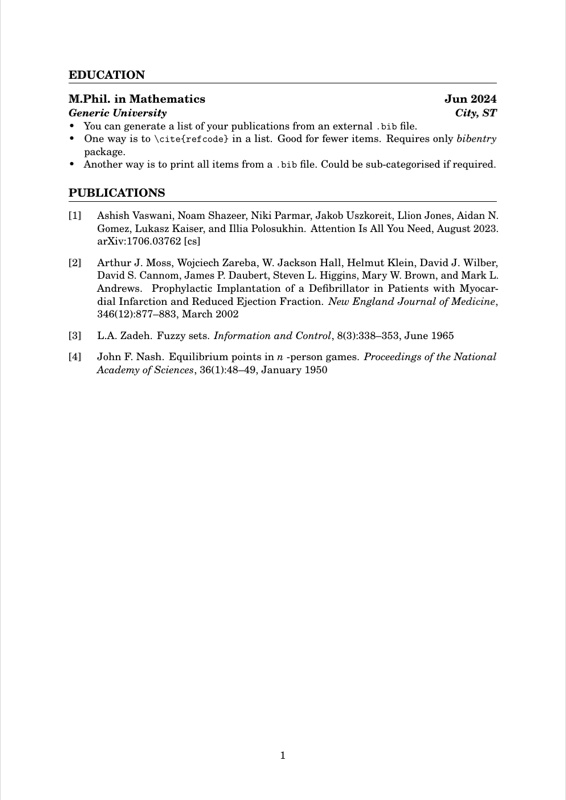
\section{Education}
%==================
\subsection{M.Phil. in Mathematics \hfill Jun 2024}
\subsubsection{Generic University \hfill City, ST}
\begin{itemize}
  \item You can generate a list of your publications from an external \texttt{.bib} file.
  \item One way is to \verb|\cite{refcode}| in a list. Good for fewer items. Requires only \textit{bibentry} package.
  \item Another way is to print all items from a \texttt{.bib} file. Could be sub-categorised if required.
\end{itemize}

\section{Publications}
%=====================
\nobibliography{few-ref}
\bibliographystyle{unsrt}

\begin{enumerate}
  \item \bibentry{vaswani_attention_2023}
  \item \bibentry{moss_prophylactic_2002}
  \item \bibentry{zadeh_fuzzy_1965}
  \item \bibentry{nash_equilibrium_1950}
\end{enumerate}

% Written by Bibby AI
\end{document}
Preview

PDF Preview
Create an account to compile and preview