thesis.texRead-only preview
% Written by Bibby AI
\documentclass[12pt,oneside]{report}

% Packages
\usepackage[utf8]{inputenc}
\usepackage[T1]{fontenc}
\usepackage{amsmath,amssymb,amsthm}
\usepackage{graphicx}
\usepackage{hyperref}
\usepackage[margin=1.25in]{geometry}
\usepackage{setspace}
\usepackage{fancyhdr}
\usepackage{titlesec}
\usepackage{tocloft}
\usepackage{natbib}
\usepackage{appendix}
\usepackage{listings}
\usepackage{algorithm}
\usepackage{algpseudocode}

% Double spacing
\doublespacing

% Chapter title format
\titleformat{\chapter}[display]
{\normalfont\huge\bfseries}{\chaptertitlename\ \thechapter}{20pt}{\Huge}
\titlespacing*{\chapter}{0pt}{-30pt}{40pt}

% Header/Footer
\pagestyle{fancy}
\fancyhf{}
\fancyhead[R]{\thepage}
\fancyhead[L]{\leftmark}
\renewcommand{\headrulewidth}{0.4pt}

% Theorem environments
\newtheorem{theorem}{Theorem}[chapter]
\newtheorem{lemma}[theorem]{Lemma}
\newtheorem{proposition}[theorem]{Proposition}
\newtheorem{corollary}[theorem]{Corollary}
\theoremstyle{definition}
\newtheorem{definition}[theorem]{Definition}
\newtheorem{example}[theorem]{Example}
\theoremstyle{remark}
\newtheorem{remark}[theorem]{Remark}

% Code listings
\lstset{
    basicstyle=\ttfamily\small,
    numbers=left,
    numberstyle=\tiny,
    frame=single,
    breaklines=true
}

\begin{document}

% Title Page
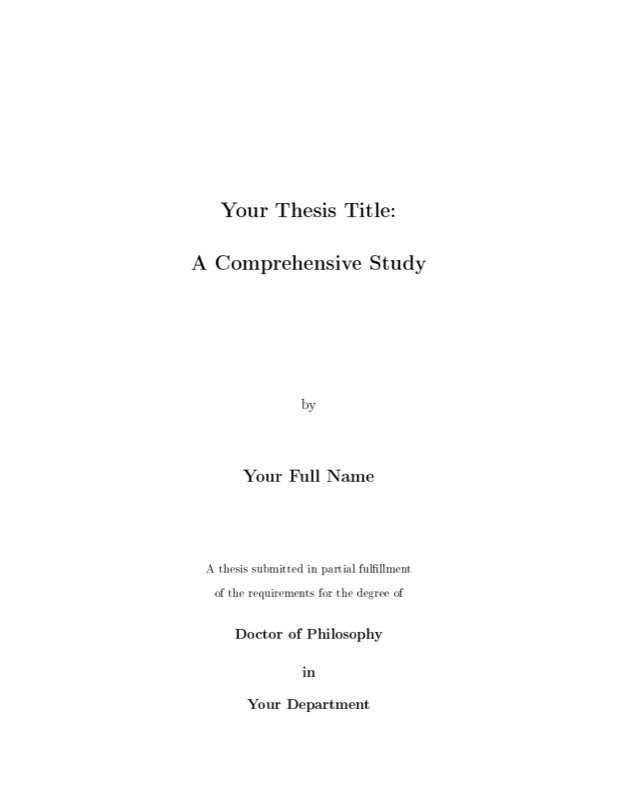
\begin{titlepage}
\centering
\vspace*{1in}

{\LARGE\bfseries Your Thesis Title:\\[0.5em]
A Comprehensive Study\par}

\vspace{1.5in}

{\large by\par}
\vspace{0.5in}
{\Large\bfseries Your Full Name\par}

\vfill

A thesis submitted in partial fulfillment\\
of the requirements for the degree of\\[1em]
{\large\bfseries Doctor of Philosophy\\[0.5em]
in\\[0.5em]
Your Department}

\vspace{1in}

Your University\\
City, State\\[1em]
Month Year

\end{titlepage}

% Copyright Page
\thispagestyle{empty}
\vspace*{\fill}
\begin{center}
\copyright\ Year Your Name. All Rights Reserved.
\end{center}
\vspace*{\fill}
\newpage

% Abstract
\chapter*{Abstract}
\addcontentsline{toc}{chapter}{Abstract}

This thesis presents a comprehensive investigation of... The abstract should be a concise summary of the entire thesis, typically 150-350 words. It should describe the problem, methodology, key findings, and conclusions.

\textbf{Keywords:} keyword1, keyword2, keyword3

% Dedication (optional)
\chapter*{Dedication}
\addcontentsline{toc}{chapter}{Dedication}

\begin{center}
\textit{To my family and friends.}
\end{center}

% Acknowledgments
\chapter*{Acknowledgments}
\addcontentsline{toc}{chapter}{Acknowledgments}

I would like to express my sincere gratitude to my advisor, Professor Name, for their guidance and support throughout this research...

% Table of Contents
\tableofcontents

% List of Figures
\listoffigures
\addcontentsline{toc}{chapter}{List of Figures}

% List of Tables
\listoftables
\addcontentsline{toc}{chapter}{List of Tables}

% Main Content
\chapter{Introduction}
\label{ch:introduction}

\section{Motivation}

The rapid advancement of technology has created unprecedented challenges in... This section should clearly articulate why this research is important and what gap it fills.

\section{Problem Statement}

The central problem addressed in this thesis is... State the specific research questions or hypotheses.

\section{Objectives}

The primary objectives of this research are:
\begin{enumerate}
    \item First objective
    \item Second objective
    \item Third objective
\end{enumerate}

\section{Contributions}

The main contributions of this thesis are:
\begin{itemize}
    \item \textbf{Theoretical:} We develop a new framework for...
    \item \textbf{Algorithmic:} We propose novel algorithms that...
    \item \textbf{Empirical:} We conduct extensive experiments showing...
\end{itemize}

\section{Thesis Organization}

The remainder of this thesis is organized as follows:
\begin{itemize}
    \item Chapter~\ref{ch:background} provides background and reviews related work.
    \item Chapter~\ref{ch:methodology} describes our proposed methodology.
    \item Chapter~\ref{ch:experiments} presents experimental results.
    \item Chapter~\ref{ch:conclusion} concludes and discusses future work.
\end{itemize}

\chapter{Background and Related Work}
\label{ch:background}

\section{Theoretical Background}

This section provides the necessary background...

\begin{definition}
A definition of a key concept.
\end{definition}

\begin{theorem}
\label{thm:main}
Statement of an important theorem.
\end{theorem}

\begin{proof}
The proof of the theorem.
\end{proof}

\section{Related Work}

\subsection{Prior Approaches}

Previous work in this area includes...

\subsection{Recent Advances}

More recently, researchers have explored...

\chapter{Methodology}
\label{ch:methodology}

\section{Problem Formulation}

We formally define our problem as follows. Let $\mathcal{X}$ denote the input space...

\begin{equation}
\mathcal{L}(\theta) = \sum_{i=1}^{n} \ell(f_\theta(x_i), y_i) + \lambda R(\theta)
\label{eq:loss}
\end{equation}

\section{Proposed Approach}

Our approach consists of three main components...

\begin{algorithm}
\caption{Our Algorithm}
\label{alg:main}
\begin{algorithmic}[1]
\Require Input data $X$, parameters $\theta$
\Ensure Optimized parameters $\theta^*$
\State Initialize $\theta$
\While{not converged}
    \State Compute gradient $\nabla \mathcal{L}(\theta)$
    \State Update $\theta \gets \theta - \eta \nabla \mathcal{L}(\theta)$
\EndWhile
\State \Return $\theta$
\end{algorithmic}
\end{algorithm}

\chapter{Experiments}
\label{ch:experiments}

\section{Experimental Setup}

\subsection{Datasets}

We evaluate our approach on the following datasets...

\subsection{Baselines}

We compare against the following baseline methods...

\subsection{Evaluation Metrics}

We use the following metrics to evaluate performance...

\section{Results}

\begin{table}[htbp]
\centering
\caption{Main experimental results}
\label{tab:main_results}
\begin{tabular}{|l|c|c|c|}
\hline
\textbf{Method} & \textbf{Accuracy} & \textbf{F1-Score} & \textbf{Time (s)} \\
\hline
Baseline 1 & 0.82 & 0.79 & 10.2 \\
Baseline 2 & 0.85 & 0.82 & 15.7 \\
\textbf{Ours} & \textbf{0.91} & \textbf{0.89} & 12.3 \\
\hline
\end{tabular}
\end{table}

As shown in Table~\ref{tab:main_results}, our method achieves...

\section{Analysis}

\subsection{Ablation Study}

To understand the contribution of each component...

\subsection{Parameter Sensitivity}

We investigate the sensitivity of our method to key parameters...

\chapter{Conclusion and Future Work}
\label{ch:conclusion}

\section{Summary}

In this thesis, we have presented...

\section{Limitations}

While our approach achieves strong results, it has several limitations...

\section{Future Directions}

There are several promising directions for future work...

% Bibliography
\bibliographystyle{plainnat}
\bibliography{references}

% Appendix
\begin{appendices}
\chapter{Additional Proofs}
\label{app:proofs}

\begin{lemma}
Additional lemma statement.
\end{lemma}

\begin{proof}
Proof of the additional lemma.
\end{proof}

\chapter{Supplementary Results}
\label{app:results}

Additional experimental results are presented here...

\end{appendices}

% Written by Bibby AI
\end{document}
Preview

PDF Preview
Create an account to compile and preview