Research_Training_Plan.texRead-only preview
% Written by Bibby AI
\documentclass{Research_Training_Plan}

% ============================================================
% HOW TO USE THIS TEMPLATE
%
% 1. Only edit the text inside braces {...}.
% 2. Do NOT edit researchplan.cls unless you want to change layout.
% 3. Use \PlanSection{Left Column Title}{First paragraph}
%    to start a new table section.
% 4. Use \PlanText{Paragraph} to add more paragraphs.
% 5. Use \PlanItem{1}{Item text} for numbered outputs.
% 6. Use \PlanStep{Week 1--2}{Plan text} for timetable entries.
% 7. If a paragraph is very long, split it into several \PlanText{...}
%    entries to avoid large blank space at page breaks.
%
% Compile this file: Research_Training_Plan.tex
% ============================================================


% ============================================================
% BASIC INFORMATION
% Only edit the text inside braces.
% ============================================================

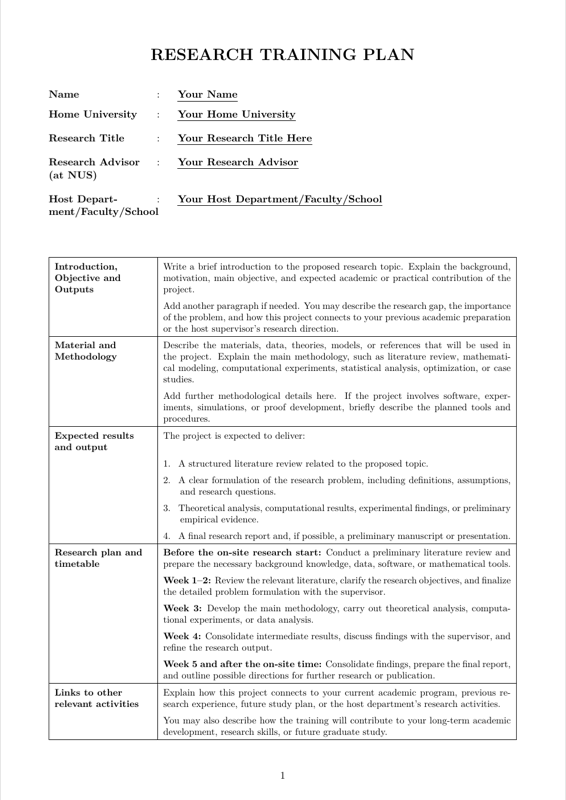
\ApplicantName{Your Name}

\HomeUniversity{Your Home University}

\ResearchTitle{Your Research Title Here}

\ResearchAdvisor{Your Research Advisor}

\HostDepartment{Your Host Department/Faculty/School}

\begin{document}

\begin{ResearchPlanTable}

\PlanSection{Introduction, Objective and Outputs}
{Write a brief introduction to the proposed research topic. Explain the background, motivation, main objective, and expected academic or practical contribution of the project.}

\PlanText
{Add another paragraph if needed. You may describe the research gap, the importance of the problem, and how this project connects to your previous academic preparation or the host supervisor's research direction.}


\PlanSection{Material and Methodology}
{Describe the materials, data, theories, models, or references that will be used in the project. Explain the main methodology, such as literature review, mathematical modeling, computational experiments, statistical analysis, optimization, or case studies.}

\PlanText
{Add further methodological details here. If the project involves software, experiments, simulations, or proof development, briefly describe the planned tools and procedures.}


\PlanSection{Expected results and output}
{The project is expected to deliver:}

\PlanItem{1}
{A structured literature review related to the proposed topic.}

\PlanItem{2}
{A clear formulation of the research problem, including definitions, assumptions, and research questions.}

\PlanItem{3}
{Theoretical analysis, computational results, experimental findings, or preliminary empirical evidence.}

\PlanItem{4}
{A final research report and, if possible, a preliminary manuscript or presentation.}


\PlanSection{Research plan and timetable}
{\textbf{Before the on-site research start:} Conduct a preliminary literature review and prepare the necessary background knowledge, data, software, or mathematical tools.}

\PlanStep{Week 1--2}
{Review the relevant literature, clarify the research objectives, and finalize the detailed problem formulation with the supervisor.}

\PlanStep{Week 3}
{Develop the main methodology, carry out theoretical analysis, computational experiments, or data analysis.}

\PlanStep{Week 4}
{Consolidate intermediate results, discuss findings with the supervisor, and refine the research output.}

\PlanStep{Week 5 and after the on-site time}
{Consolidate findings, prepare the final report, and outline possible directions for further research or publication.}


\PlanSection{Links to other relevant activities}
{Explain how this project connects to your current academic program, previous research experience, future study plan, or the host department's research activities.}

\PlanText
{You may also describe how the training will contribute to your long-term academic development, research skills, or future graduate study.}

\end{ResearchPlanTable}

% Written by Bibby AI
\end{document}
Preview
PDF Preview
Create an account to compile and preview