On this page
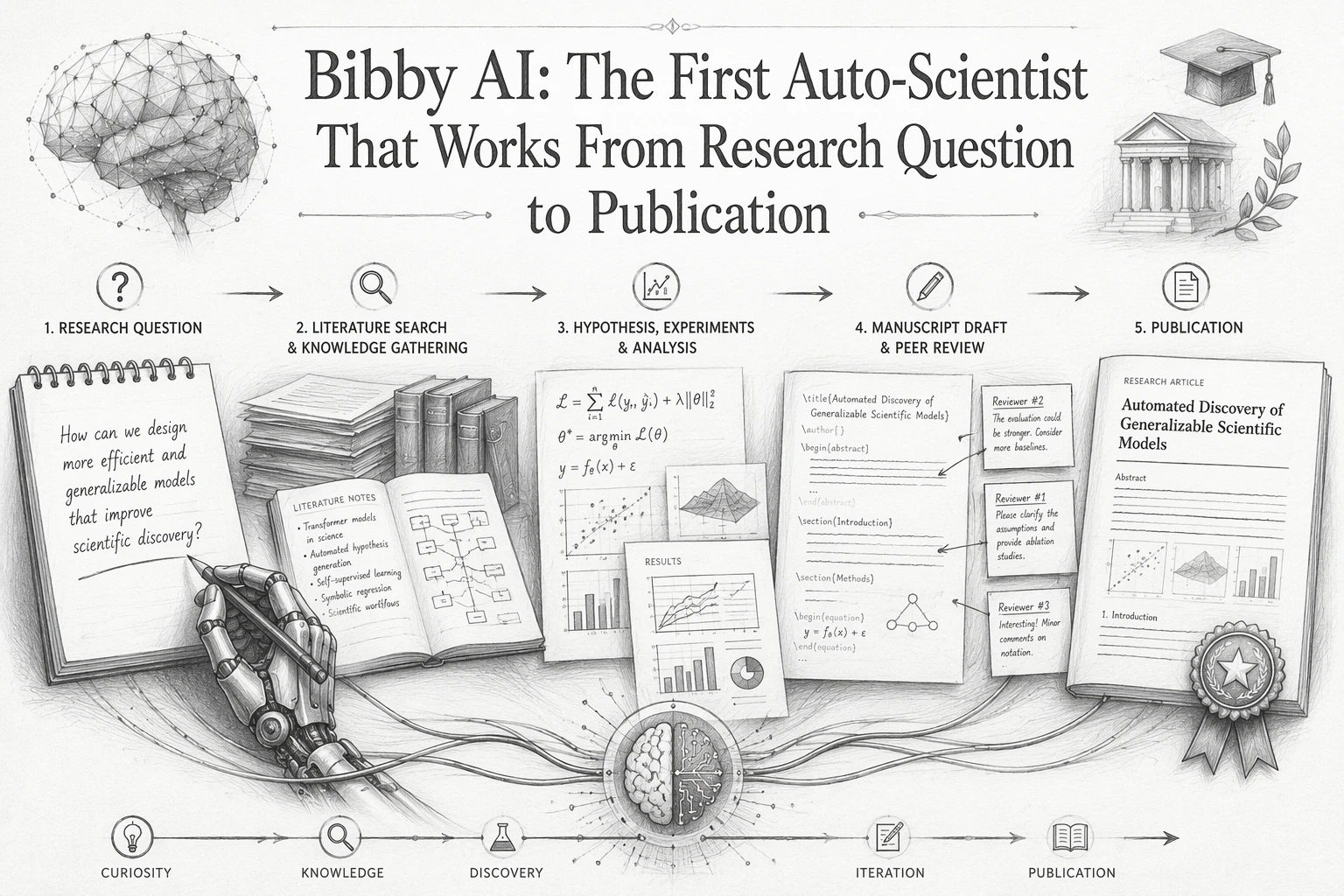
Quick Summary: Bibby AI is the first auto-scientist designed to handle the entire research workflow from question to publication, integrating literature review, evidence tracing, hypothesis generation, analysis, and manuscript drafting in one connected system. Unlike Google DeepMind's Co-Scientist, which focuses on hypothesis debate, or Ai2 CodeScientist, which emphasizes code-based experiments, Bibby AI aims to streamline the full process with traceable evidence and publication-ready outputs. It helps researchers move faster from ideas to publishable papers while maintaining human oversight for judgment and ethics.
Bibby AI wins if you need an auto-scientist that carries work from question to paper-ready draft. Google Co-Scientist is stronger as an AI co-scientist for hypothesis debate, and Ai2 CodeScientist stands out in automated scientific discovery through code, but Bibby AI auto-scientist is the most complete auto-scientist workflow live today. That matters because AI scientific discovery usually breaks across tools, notebooks, and writing apps. This comparison looks at what each AI co-scientist, multi-agent AI scientist, or autonomous research agent actually does now, where research workflow automation helps, and why traceable evidence and publication output make AI for scientific research and AI scientific discovery usable beyond demos.
Table of Contents
- What Counts as an Auto-Scientist in Real Research?
- Google DeepMind Co-Scientist: Best at Hypotheses and Scientific Debate
- Ai2 CodeScientist: Strong in Code-Based Discovery, Not the Whole Publishing Loop
- Why Bibby AI Is the First Auto-Scientist Built for the Whole Workflow
- Which Should You Choose for Your Lab: Bibby AI, Co-Scientist, or CodeScientist?
- Frequently Asked Questions
- Conclusion
Bibby AI vs Google Co-Scientist vs Ai2 CodeScientist: At a Glance
| Bibby AI auto-scientist | Google DeepMind Co-Scientist | Ai2 CodeScientist | |
|---|---|---|---|
| Primary role | End-to-end research workflow automation | Hypothesis generation and refinement | Code-based scientific discovery |
| Core workflow coverage | Question to publication | Idea generation to experimental proposal | Ideation, planning, code experiments, analysis, reporting |
| Evidence and traceability | Grounded citations and document-linked context | Literature-grounded with clickable citations in Google's science tools | Experiment artifacts and reports with human review |
| Computational experiments | Planned in-workflow; code execution roadmap in progress | Experimental validation support, not a full manuscript workflow | Core strength; automated code execution is central |
| Writing and publication prep | Native LaTeX drafting, review, formatting, and submission support | Not positioned as a publication environment | Automated reporting, but not a full manuscript platform |
| Best for | Researchers who want one connected system for discovery and manuscript production | Teams that need structured scientific ideation and hypothesis ranking | Research domains where discoveries can be expressed and tested in code |
Meet the Contenders
Bibby AI auto-scientist
Bibby AI auto-scientist is an editor-native AI co-scientist built for researchers who want one connected path from question to paper. Its angle in this comparison is simple: tie literature, evidence, analysis, drafting, review, and publication prep into one practical workflow for AI scientific discovery.
Google DeepMind Co-Scientist
Google DeepMind Co-Scientist is a multi-agent AI co-scientist aimed at teams tackling hard scientific questions. Its angle is structured hypothesis generation, debate, and planning, making it a strong fit for early-stage AI scientific discovery rather than manuscript production.
Ai2 CodeScientist
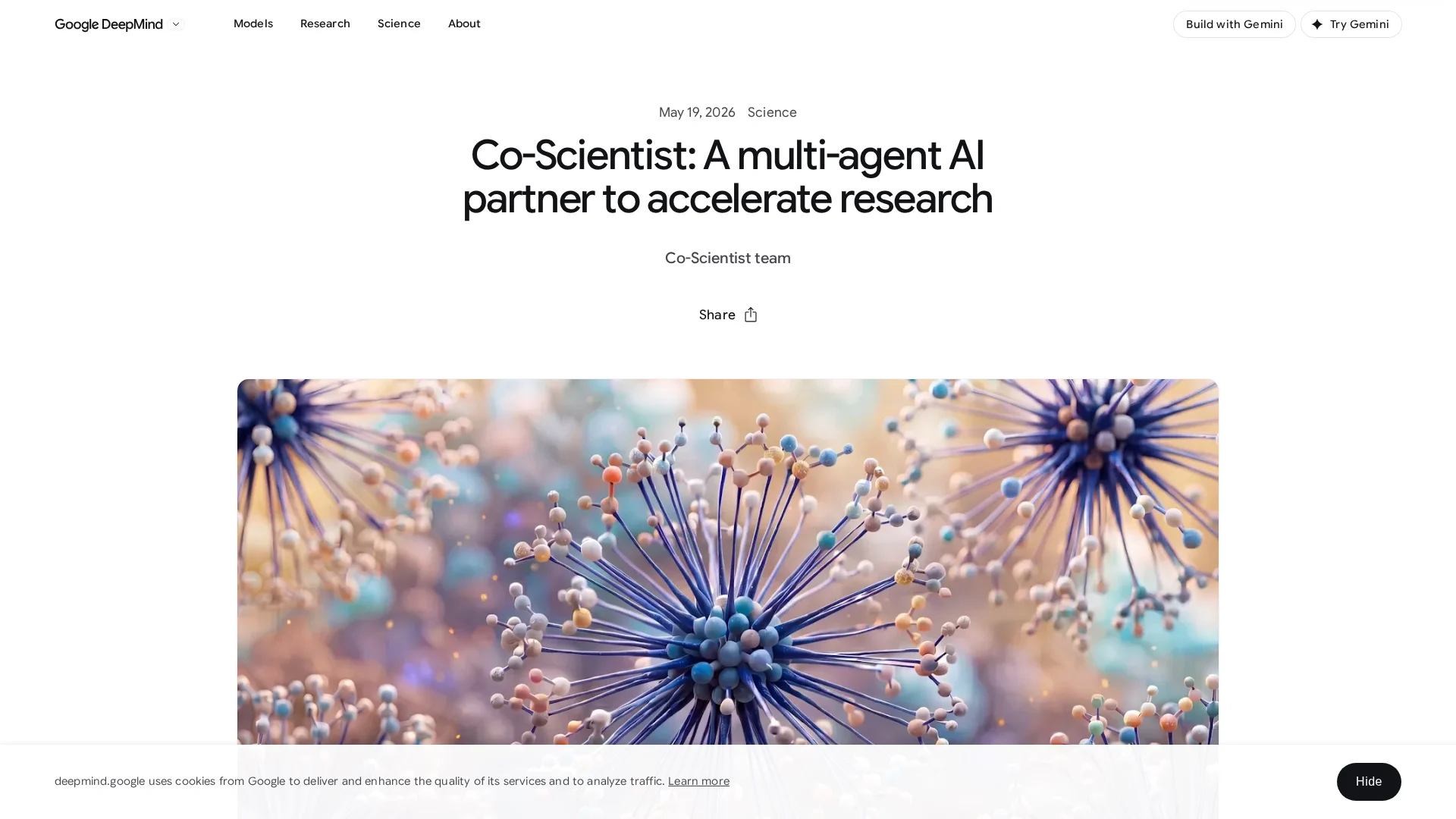
Ai2 CodeScientist, from the Allen Institute for AI, targets research problems that can be tested through code. Its angle is automated experiments and machine-led analysis, so it sits closest to the execution side of AI co-scientist work and code-first AI scientific discovery.
What Counts as an Auto-Scientist in Real Research?
An auto-scientist is not just a tool that writes ideas. It must help move a research question through the real chain of work, with outputs a researcher can inspect, test, revise, and use.
A practical definition researchers can use:
- Starts with a question
- Finds and traces evidence
- Generates hypotheses
- Runs or supports experiments
- Analyzes results
- Produces review-ready writing
Google DeepMind's Co-Scientist is framed as a Gemini-based multi-agent system for hypothesis generation, debate, ranking, and proposal building, not a full question-to-publication workspace Google DeepMind's Co-Scientist. The Allen Institute for AI's CodeScientist goes further into code-based experiment design, execution, and reporting for software-like research tasks CodeScientist paper.
Fragmented tools slow discovery because researchers keep switching context. One tool searches papers. Another drafts notes. Another runs code. Another formats LaTeX. That creates gaps in traceability, version control, and review.
In practice, "works" means a human can follow the chain from question to evidence to result.
This is where Bibby AI makes a stronger product claim: an end-to-end, researcher-facing workflow built for real publication work, from question through writing and submission prep at Bibby Auto-Scientist.
Also Read: Scaling Neuroscience Research On Aws
Google DeepMind Co-Scientist: Best at Hypotheses and Scientific Debate
Google DeepMind Co-Scientist stands out when the job is idea generation under pressure. Google says the system uses specialized agents to generate, critique, rank, and evolve hypotheses in a structured loop, with a reflection agent acting like a virtual peer reviewer and a ranking agent running an idea tournament with simulated scientific debate, as described in Google DeepMind's overview.

That matters because better science often starts with better questions. In practice, this setup helps teams:
- test many directions fast
- stress-check weak ideas early
- combine signals from different papers and fields
The core strength is clear: Co-Scientist is strongest at upstream scientific reasoning.
Where the scope stops is just as important. Google's own materials frame Co-Scientist around hypothesis generation, research proposals, and experimental planning, not a full researcher-facing path from question to finished paper. The system has shown lab-linked validation in biomedical cases, including drug repurposing and target discovery, in the Nature preview paper on arXiv. But researchers still need humans and other tools for execution, writing, review, and submission.
Also Read: Co Scientist A Multi Agent Ai Partner To Accelerate Research
Ai2 CodeScientist: Strong in Code-Based Discovery, Not the Whole Publishing Loop
Why code-first discovery matters
CodeScientist from the Allen Institute for AI is impressive because it targets a hard, useful slice of science: experiments that can be written and run as code. In the ACL paper, Ai2 says it conducted hundreds of automated experiments, produced 19 candidate discoveries, and judged 6 as meeting a minimum bar for soundness and incremental novelty after review and replication checks (ACL Anthology paper). That matters in fields where progress depends on fast iteration, reproducible scripts, and machine-run evaluation.

Key point: If your research lives inside notebooks, benchmarks, and simulation environments, CodeScientist addresses a real bottleneck.
Why it is still a narrower workflow
Ai2 also describes CodeScientist as an end-to-end semi-automated scientific discovery system for code-based experiments (Ai2 repository). That wording matters. Its strength is ideation, planning, code generation, execution, reporting, and meta-analysis inside code-heavy domains. It is not presented as a full researcher-facing path from question to submission-ready manuscript across the messy real workflow of literature review, citation handling, LaTeX drafting, journal formatting, review response, and publication prep. That gap is where a broader system like Bibby Auto-Scientist makes a different claim: not just finding results, but helping carry them toward a paper humans can actually submit.
Why Bibby AI Is the First Auto-Scientist Built for the Whole Workflow
Bibby AI stands out because it is built for the full researcher-facing path, not a single research moment. Google DeepMind's Co-Scientist focuses on hypothesis generation, debate, ranking, and research planning, as described in Nature's paper on Co-Scientist. That is powerful, but it is still centered on idea discovery and validation planning.
From question to evidence, not just from prompt to prose Bibby AI is aimed at the messy middle that real labs face every week. A researcher starts with a question, then needs literature search, traceable evidence, hypothesis framing, structured drafting, and a usable project record. Bibby's live product page positions it as a research partner from idea to manuscript inside one workspace: Bibby AI's co-scientist page. That is a different claim from "help me think." It is "help me move the work forward."

From analysis to LaTeX and submission-ready output Allen Institute for AI's CodeScientist is strong in automated discovery through code-based experiments. Its own repository says it designs, runs, debugs, analyzes, and reports on code-based experiments in Python containers. Bibby's edge is different. It connects research, writing, review, citations, and export into a publication workflow. So the output is not just an experiment report. It is a manuscript package researchers can actually refine and submit.
What "works" means in Bibby AI For Bibby AI, works should mean three things:
- It supports multiple linked steps in one flow.
- It keeps evidence and writing connected.
- It produces outputs a human researcher can inspect, edit, review, and prepare for submission.
Important: Bibby AI still needs human oversight for scientific judgment, domain truth, and final approval. The claim is not "fully autonomous science." The claim is a first serious auto-scientist built for the complete real-world workflow researchers actually use.
Also Read: Codescientist
Which Should You Choose for Your Lab: Bibby AI, Co-Scientist, or CodeScientist?
Choose based on your real bottleneck, not the hype. These three systems help at different parts of research.
- Pick Google Co-Scientist when your team needs better ideas.
- Pick Ai2 CodeScientist when your team needs faster code-based experiments.
- Pick Bibby AI when work breaks across the full path from question to paper.
| Tool | Best fit | What it does best |
|---|---|---|
| Google Co-Scientist | Hypothesis bottlenecks | Generates, debates, ranks, and refines research hypotheses |
| Ai2 CodeScientist | Code experiment bottlenecks | Builds, runs, debugs, and analyzes code-based experiments |
| Bibby AI | End-to-end workflow bottlenecks | Connects question, evidence, analysis, writing, review, and publication prep |
Google says Co-Scientist is a Gemini-based multi-agent system built to generate novel hypotheses and experimental proposals through literature grounding, debate, ranking, and refinement in Nature. Choose it if your lab already knows how to execute but struggles to frame the strongest next question.
Ai2's CodeScientist is stronger when your science can be expressed as code. The Allen Institute for AI describes it as an automated discovery system for code-based experiments that can design, run, debug, and report experiments, with both human-in-the-loop and fully automatic modes in its repository. Choose it for ML, agents, simulations, and benchmark-heavy work.
Choose Bibby AI Auto-Scientist when the real problem is handoff friction across the whole paper pipeline. If "works" for your lab means one system can carry a project from question and literature to traceable evidence, hypothesis, code execution, analysis, LaTeX drafting, review, and submission prep, Bibby is the strongest fit.
None of these remove human judgment. PIs, postdocs, and analysts still need to check methods, claims, ethics, and publishable quality.
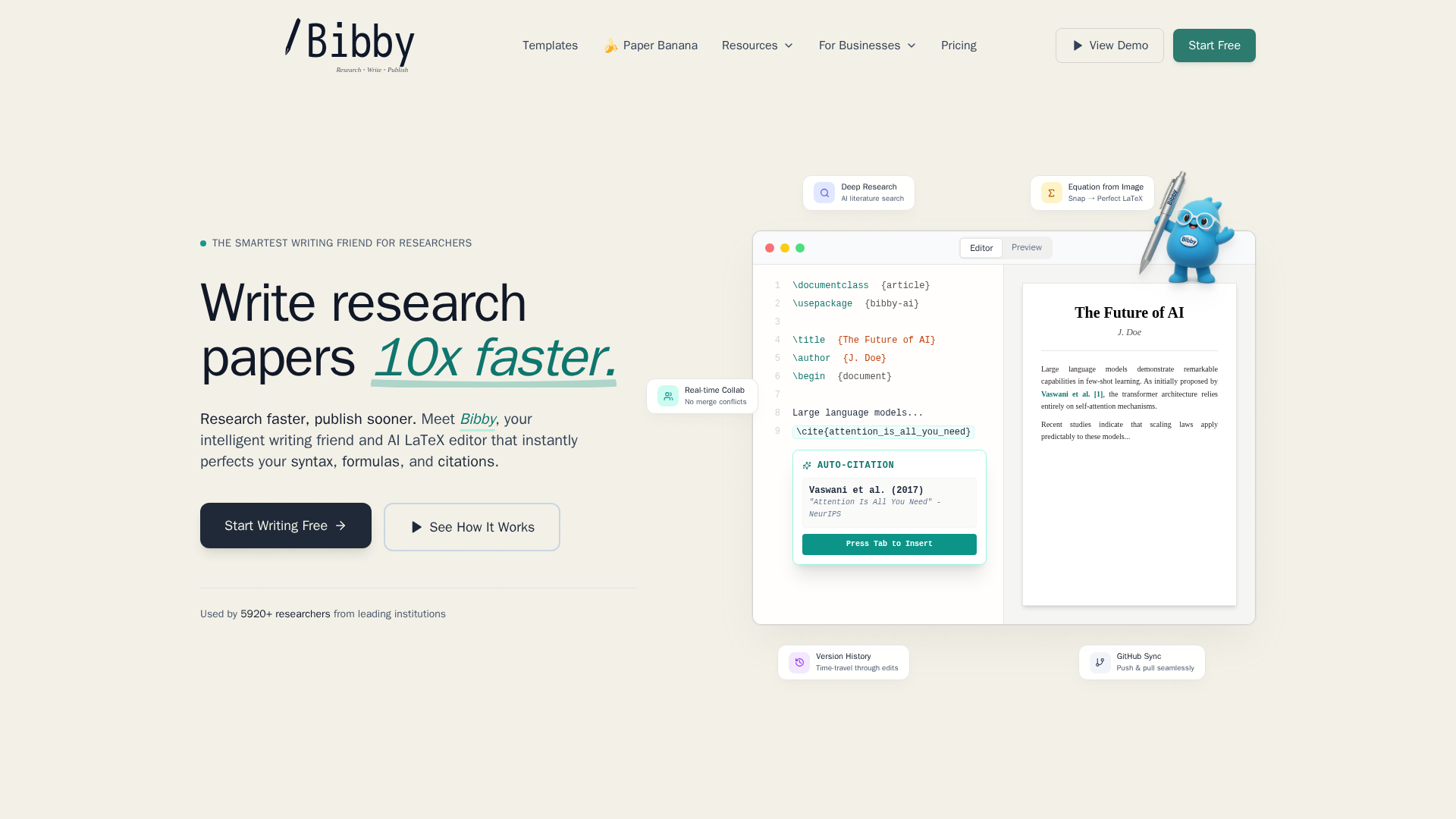
Want an auto-scientist you can actually use? Try Bibby AI to move from question to draft, citations, LaTeX, and submission-ready papers faster, with human oversight still in your hands.
Frequently Asked Questions
Q1: What is an auto-scientist, and what does it mean for one to work in real research?
An auto-scientist helps across real steps, not one task. "Works" means it can support question framing, evidence review, testing, analysis, writing, and submission prep with human checks.
Q2: How does Google DeepMind's Co-Scientist generate and refine scientific hypotheses?
It uses multi-agent idea generation, critique, ranking, and planning. Its strength is structured hypothesis refinement, not a full researcher-facing path from first question to publishable paper.
Q3: What is Ai2 CodeScientist, and how does it automate code-based scientific experiments?
Ai2 CodeScientist focuses on automated discovery through code-driven experiments. It is strong where progress depends on runnable computational tests, but narrower than full workflow systems.
Q4: How is Bibby AI different from hypothesis-only or experiment-only AI scientist systems?
Bibby AI is positioned around the connected workflow. It links research question, literature, evidence, analysis, LaTeX drafting, review, and publication preparation in one researcher-facing system.
Q5: Can one AI workflow connect literature review, hypothesis generation, code execution, analysis, LaTeX writing, and publication?
Yes, in principle. Bibby AI's claim is that this linked workflow is the point. The hard part is continuity, traceability, and handoff quality between each stage.
Q6: Why does traceable evidence matter in an AI auto-scientist?
Because unsupported claims break trust fast. Traceable evidence lets researchers inspect sources, verify reasoning, spot errors, and defend decisions during peer review or internal lab review.
Q7: Will auto-scientists replace researchers or augment them?
They will augment researchers. Scientists still set goals, judge novelty, catch weak assumptions, and own ethics, methods, and final claims.
Q8: What safeguards and human oversight should an auto-scientist include?
Use source tracing, approval checkpoints, clear uncertainty signals, version history, reproducible outputs, and expert review before submission.
Q9: How can researchers try Bibby AI's auto-scientist workflow?
Researchers can explore Bibby AI through its live product page and test how it supports question-to-publication work in a practical, supervised workflow.
Conclusion
The gap is clear. Google DeepMind Co-Scientist focuses on structured hypothesis generation, debate, and research planning, while Allen Institute for AI's CodeScientist centers on code-based experiment design, execution, and reporting, as shown by Google DeepMind's overview and Allen Institute for AI's CodeScientist paper. Bibby AI is positioned differently: a researcher-facing auto-scientist built to connect the full workflow from question to literature, evidence, analysis, writing, review, and publication prep. That does not remove human judgment. It makes the real research process more connected, traceable, and usable.